The best AI recruiting companies in 2026 include platforms like Metaview, HireEZ, Paradox, Gem, Eightfold, Humanly, and Arbi—each addressing different hiring bottlenecks from sourcing and screening to scheduling and compliance. AI recruiting platforms use machine learning and automation to streamline talent acquisition workflows, helping HR teams reduce time-to-fill and improve candidate quality without scaling headcount proportionally. The right choice depends on your company size, budget tier, existing ATS compatibility, and which specific hiring challenges you need to solve.
This guide compares the top AI recruitment companies by use case, features, and pricing to help talent acquisition leaders, scaling founders, and recruiters find the platform that fits their workflow.
What Is an AI Recruiting Platform?
An AI recruiting platform is software that applies artificial intelligence to automate and enhance one or more stages of the hiring process—from sourcing candidates to screening resumes, scheduling interviews, and engaging applicants. These platforms use machine learning algorithms to analyze large volumes of candidate data, identify patterns that predict job fit, and execute repetitive tasks that would otherwise consume recruiter time.
The core distinction between AI recruiting software and traditional applicant tracking systems lies in intelligence and autonomy. Where a standard ATS stores and organizes applications, an AI-powered recruitment tool actively surfaces top candidates, ranks them by relevance, drafts outreach messages, and even conducts initial screening conversations through chatbots.
AI recruiting platforms typically fall into several functional categories. Some focus narrowly on sourcing, using AI to scan databases and social networks for passive candidates. Others specialize in screening, applying natural language processing to parse resumes and match qualifications against job requirements. A growing number offer end-to-end solutions that combine multiple capabilities into unified workflows.
For a deeper look at how these platforms differ from broader best AI hiring platforms, it helps to understand that recruiting-specific tools prioritize top-of-funnel activities while hiring platforms may extend into onboarding and workforce planning.
The practical value for HR teams comes from scale. AI tools can process thousands of applications in minutes, maintain consistent evaluation criteria, and provide 24/7 candidate engagement through conversational AI—capabilities that manual processes simply cannot match as hiring volumes grow.
How to Evaluate AI Recruitment Software by Hiring Bottleneck
The most effective way to evaluate AI recruitment solutions is by mapping each platform's strengths to your specific hiring bottleneck—whether that's sourcing, screening, scheduling, or compliance. Different tools excel at different stages, and choosing based on workflow fit rather than brand recognition leads to better outcomes.
Sourcing bottlenecks occur when your team struggles to find enough qualified candidates to fill the pipeline. AI sourcing tools address this by scanning professional networks, resume databases, and public profiles to identify passive candidates who match your criteria. Platforms like HireEZ and Gem specialize in this area, using AI to surface candidates your competitors might miss. For a detailed breakdown of sourcing-specific options, see our guide to top AI sourcing agents in HR tech.
Screening bottlenecks emerge when recruiters spend excessive time reviewing applications manually. AI screening tools parse resumes, extract relevant qualifications, and rank candidates against job requirements automatically. This reduces time-to-shortlist from days to hours while maintaining consistent evaluation standards across all applicants.
Scheduling bottlenecks slow hiring when coordinating interviews becomes a logistical nightmare. Platforms like GoodTime and Paradox automate calendar coordination, send reminders, and reduce no-show rates through intelligent follow-up sequences. For high-volume hiring, this single capability can dramatically compress time-to-fill.
Compliance bottlenecks affect organizations in regulated industries or those prioritizing diversity initiatives. Some AI recruiting platforms include bias detection features, structured interview frameworks, and audit trails that document hiring decisions for legal defensibility.
When evaluating any AI recruiting software, start by identifying which bottleneck costs your team the most time or creates the greatest risk. Then prioritize platforms that demonstrate documented outcomes in that specific area rather than selecting based on feature count alone.
Top AI Recruiting Companies and Platforms for 2026
The leading AI recruiting companies for 2026 span a range of specializations, from conversational AI assistants to comprehensive talent intelligence platforms. Here are the platforms earning the most attention from HR leaders and industry analysts this year.
Metaview focuses on interview intelligence, using AI to transcribe and analyze hiring conversations. The platform transforms messy interview notes into structured, searchable records that help teams make more consistent hiring decisions and reduce bias in evaluations.
HireEZ (formerly Hiretual) specializes in AI-powered sourcing, scanning over 800 million candidate profiles to surface talent that matches specific role requirements. The platform integrates with major ATS systems and provides engagement tracking to measure outreach effectiveness.
Paradox (Olivia) offers a conversational AI assistant that handles candidate screening, interview scheduling, and FAQ responses around the clock. The platform excels in high-volume hiring environments where immediate candidate engagement improves conversion rates.
Gem combines sourcing automation with CRM functionality, helping recruiting teams build and nurture talent pipelines over time. The platform's AI suggests optimal outreach timing and messaging based on historical engagement data.
Eightfold provides a talent intelligence platform that uses deep learning to match candidates to roles based on skills and career trajectories rather than keyword matching alone. The platform also supports internal mobility by identifying existing employees suited for open positions.
GoodTime automates interview scheduling and coordination, reducing the administrative burden on recruiting coordinators. The platform's AI optimizes interviewer selection and calendar management to accelerate hiring timelines.
Humanly targets high-volume hiring with AI-powered screening, scheduling, and interview automation. The platform helps teams fill roles faster while reducing no-show rates through intelligent candidate engagement.
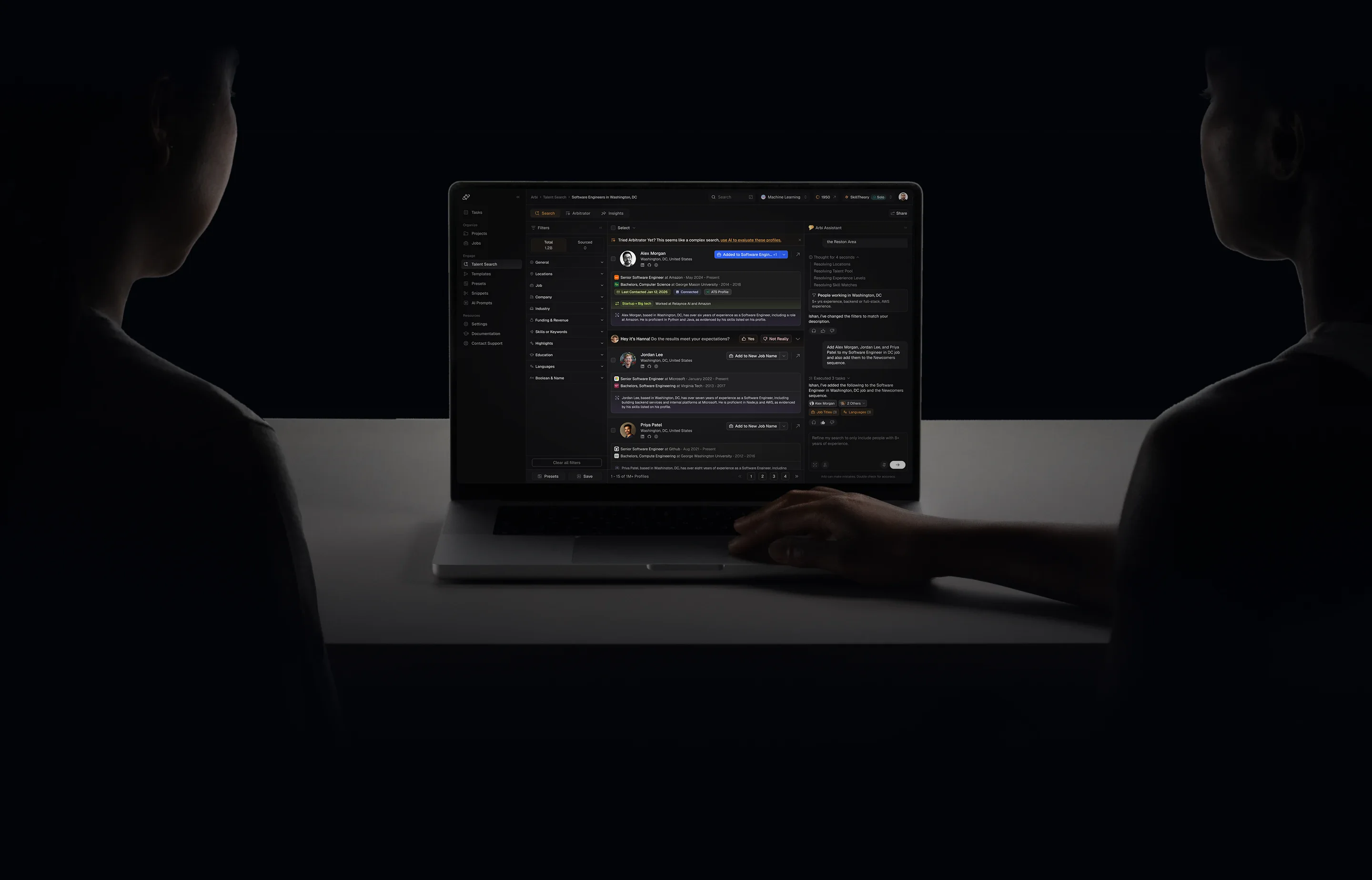
Arbi by Neuroscale brings a differentiated approach with a validated government deployment track record, offering AI recruiting features such as automatic candidate sourcing, screening, and outreach. Arbi integrates with virtually any ATS system, and provides engagement tracking to measure outreach effectiveness.
For a more comprehensive breakdown of these and additional platforms, our dedicated best AI recruiting platforms for 2026 guide provides deeper feature comparisons and use-case recommendations.
AI Recruiting Tools Compared by Company Size and Budget
AI recruiting tools vary significantly in pricing structure, implementation complexity, and ideal company fit. Matching your organization's size and budget to the right platform tier prevents overspending on enterprise features you won't use or underinvesting in capabilities you actually need.
Startups and small teams (under 50 employees) typically benefit from AI tools for recruiting that offer straightforward pricing, minimal implementation overhead, and integration with common ATS platforms. These organizations often operate with a single recruiter or founder handling hiring, making ease of use paramount. Platforms with per-seat or pay-as-you-go pricing models reduce financial risk during unpredictable hiring cycles.
Mid-sized companies (50-500 employees) usually have dedicated talent acquisition teams and more complex hiring workflows. At this stage, AI recruiting platforms that offer workflow customization, team collaboration features, and robust reporting become valuable. Budget allocation typically shifts from pure cost minimization toward ROI optimization—paying more for tools that demonstrably reduce time-to-fill or improve quality-of-hire metrics.
Enterprise organizations (500+ employees) require AI-powered recruitment software that scales across multiple business units, geographies, and compliance requirements. These buyers prioritize security certifications, API flexibility, dedicated support, and the ability to handle tens of thousands of applications annually. Enterprise contracts often involve custom pricing based on hiring volume and feature requirements.
Understanding the true cost of AI recruiting tools in 2026 requires looking beyond subscription fees to include implementation time, training requirements, integration costs, and ongoing maintenance. A platform that appears cheaper on paper may cost more in total when these factors are included.
Free tiers and trials exist for some AI recruitment companies, though capabilities are typically limited. These options work well for testing core functionality before committing to paid plans, but rarely provide the full feature set needed for sustained hiring operations.
Key Features to Look for in AI-Powered Recruitment Software
The most valuable features in AI-powered recruitment tools directly address efficiency, quality, and compliance—the three pillars that determine whether a platform delivers meaningful ROI. Prioritize capabilities that solve your documented pain points rather than chasing feature lists.
Resume parsing and candidate matching forms the foundation of most AI recruiting software. Look for platforms that go beyond keyword matching to understand skills, experience context, and career progression. The best tools identify candidates who may not use exact job description language but possess equivalent qualifications.
Conversational AI and chatbots enable 24/7 candidate engagement without requiring recruiter availability. Effective implementations handle screening questions, schedule interviews, answer FAQs, and maintain candidate interest during hiring delays. Poor implementations frustrate candidates with rigid scripts and limited understanding.
Interview intelligence captures and analyzes hiring conversations to improve consistency and reduce bias. Features include automated transcription, structured scoring frameworks, and analytics that identify patterns in successful hires. This capability proves especially valuable for distributed teams where interview calibration is challenging.
Workflow automation connects AI capabilities to your existing processes through integrations with ATS platforms, calendar systems, and communication tools. Evaluate how seamlessly a platform fits into your current tech stack rather than requiring wholesale process changes.
Analytics and reporting transform hiring data into actionable insights. Look for dashboards that track time-to-fill, source effectiveness, candidate drop-off points, and diversity metrics. The best platforms surface recommendations rather than just displaying numbers.
Bias detection and compliance tools help organizations maintain fair hiring practices and document decisions for legal defensibility. These features matter most in regulated industries or for companies with formal diversity commitments.
For a side-by-side evaluation of how different platforms deliver these capabilities, our top talent sourcing platforms comparison provides detailed feature breakdowns.
Find the Right AI Hiring Platform for Your Team
Selecting the right AI hiring platform requires matching your specific hiring challenges, team capabilities, and budget constraints to a platform's documented strengths. The best choice for a high-volume retail employer differs substantially from the ideal solution for a specialized technical recruiting team.
Start by auditing your current hiring process to identify where time and quality losses occur. If your team spends excessive hours on initial screening, prioritize platforms with strong resume parsing and automated candidate ranking. If scheduling coordination creates delays, focus on tools with robust calendar automation. If sourcing passive candidates is your primary challenge, evaluate platforms with deep database access and outreach automation.
Consider your existing technology stack when evaluating integration requirements. An AI recruiting platform that doesn't connect smoothly with your ATS creates friction that undermines adoption. Most leading platforms offer native integrations with major systems like Greenhouse, Lever, and Workday, but verify compatibility before committing.
Evaluate vendor track records through case studies, customer references, and independent reviews. Platforms with documented outcomes in your industry or company size bracket provide more reliable expectations than generic marketing claims. Organizations with compliance requirements should specifically verify that vendors can demonstrate audit trails and bias mitigation capabilities.
Request trials or pilot programs before signing annual contracts. Testing a platform with real hiring workflows reveals usability issues and integration challenges that demos cannot surface. Pay attention to how quickly your team adopts the tool and whether it genuinely reduces workload or simply shifts it.
When you're prepared to evaluate pricing and implementation timelines, Neuroscale's pricing page offers transparent information to support your decision process.
The AI recruiting landscape continues evolving rapidly, with new capabilities emerging throughout 2026. Choosing a platform with a clear product roadmap and responsive development team positions your organization to benefit from improvements rather than being locked into static functionality.
Frequently Asked Questions
What is AI recruiting and how does it work?
AI recruiting uses artificial intelligence to automate and enhance hiring processes including sourcing candidates, screening resumes, scheduling interviews, and engaging applicants. These platforms apply machine learning algorithms to analyze candidate data, identify patterns that predict job fit, and execute repetitive tasks at scale. The technology enables HR teams to process thousands of applications quickly while maintaining consistent evaluation criteria across all candidates.
What are the best AI recruiting platforms to consider in 2026?
The best AI recruiting platforms for 2026 include Metaview for interview intelligence, HireEZ for AI-powered sourcing, Paradox for conversational AI, Gem for pipeline management, Eightfold for talent intelligence, GoodTime for scheduling automation, Humanly for high-volume hiring, and Arbi by Neuroscale for compliance-focused organizations. The right choice depends on your specific hiring bottleneck, company size, and budget tier rather than a universal ranking.
Will AI recruiting software replace human recruiters?
AI recruiting software will not replace human recruiters but will significantly change their role. These tools automate repetitive tasks like resume screening, initial outreach, and interview scheduling, freeing recruiters to focus on relationship building, candidate assessment, and strategic hiring decisions. The most effective implementations combine AI efficiency with human judgment, particularly for final hiring decisions and complex negotiations.
What tasks can AI recruiting tools actually automate?
AI recruiting tools can automate resume parsing and candidate ranking, initial screening conversations through chatbots, interview scheduling and calendar coordination, candidate outreach and follow-up sequences, and interview transcription and note organization. More advanced platforms also automate bias detection, compliance documentation, and predictive analytics for candidate success. The specific automation capabilities vary by platform and pricing tier.
How much does AI recruiting software typically cost?
AI recruiting software pricing ranges from free tiers with limited features to enterprise contracts exceeding six figures annually. Most mid-market platforms charge between $200-$500 per user per month, while some offer per-hire or per-job pricing models. Total cost of ownership includes implementation, training, and integration expenses beyond subscription fees. Budget-conscious buyers should evaluate ROI based on time savings and quality improvements rather than subscription cost alone.
Is there a free AI recruiting platform available?
Some AI recruiting platforms offer free tiers or extended trials with limited functionality. These options typically restrict the number of job postings, candidate searches, or user seats available. Free versions work well for testing core capabilities or handling occasional hiring needs but rarely provide sufficient features for sustained recruiting operations. Most organizations eventually upgrade to paid plans as hiring volume increases.
What should companies look for when choosing an AI hiring platform?
Companies should prioritize AI hiring platforms that address their specific bottleneck—whether sourcing, screening, scheduling, or compliance. Key evaluation criteria include integration compatibility with existing ATS systems, documented outcomes from similar organizations, transparent pricing structures, and responsive customer support. Request trials to test real workflows before committing, and verify that the platform's feature roadmap aligns with your evolving hiring needs.