The best AI recruiting software in 2026 depends on which hiring bottleneck you need to solve: sourcing tools like HireEZ and SeekOut excel at building candidate pipelines, screening tools like Truffle and GoPerfect automate resume review and assessments, and outreach tools like Gem and Paradox handle candidate engagement at scale. For teams seeking a single platform that collapses all three functions into one auditable workflow, full-funnel AI recruiting platforms eliminate the integration debt that comes with combining multiple point solutions. This guide compares the leading AI recruitment tools across each category, provides evaluation criteria tailored to talent acquisition leaders and HR tech evaluators, and helps you determine whether a specialized stack or an all-in-one platform fits your hiring operation.
How to Evaluate AI Recruiting Platforms in 2026
Choosing the right AI recruiting platform requires evaluating five core dimensions before comparing specific tools: candidate matching accuracy, outreach automation capabilities, bias mitigation features, ATS integration depth, and total cost of ownership.
Candidate matching accuracy determines whether the AI surfaces genuinely qualified candidates or floods your pipeline with noise. The best AI recruiting tools use skills-based matching rather than keyword parsing, analyzing work history patterns and inferring capabilities that traditional resume filters miss. Ask vendors how their matching algorithms are trained and whether they can demonstrate precision rates on roles similar to yours.
Outreach automation separates tools that save time from tools that actually improve response rates. Look for platforms that personalize messages at scale, sequence follow-ups intelligently, and track engagement metrics that help you refine your approach. Basic mail-merge functionality dressed up as AI will not move the needle on candidate engagement.
Bias mitigation has moved from a nice-to-have to a procurement requirement for enterprise buyers. Evaluate whether the platform offers explainable AI decisions, allows you to audit scoring criteria, and provides demographic reporting on pipeline composition. Understanding the true cost of AI recruiting tools includes accounting for compliance risk if your AI cannot demonstrate fair hiring practices.
ATS integration depth affects how quickly you can realize value from any AI recruiting software. Shallow integrations that require manual data exports create friction that erodes adoption. Deep, bidirectional integrations that sync candidate status, interview feedback, and hiring outcomes in real time are essential for teams running high-volume workflows.
Pricing transparency remains inconsistent across the category. Some AI recruiting platforms charge per seat, others per job posting, and others per successful hire. Calculate your expected cost-per-hire under each model before committing, and factor in implementation costs, training time, and the opportunity cost of a lengthy rollout.
AI Sourcing Tools: Best for Building Candidate Pipelines
AI sourcing tools automate the process of identifying and aggregating potential candidates from across the web, professional networks, and proprietary databases, dramatically reducing the manual hours recruiters spend on top-of-funnel research.
HireEZ is widely recognized for its ability to search across multiple platforms simultaneously, pulling candidate profiles from professional networks, GitHub, and niche talent communities into a unified view. Its AI ranks candidates based on fit signals and provides contact information, making it a strong choice for teams that need to build pipelines quickly for technical or specialized roles.
SeekOut offers similar multi-source aggregation with particular strength in diversity sourcing. Its filters allow recruiters to surface underrepresented candidates intentionally, and its talent analytics help TA leaders understand where their pipelines skew and why. For organizations with diversity hiring mandates, SeekOut addresses a specific compliance and culture-building need.
Findem takes a different approach by constructing what it calls "attribute-based" candidate profiles, inferring skills and career trajectory patterns from fragmented data across the web. This makes it particularly useful for roles where traditional keyword searches fail to capture the right talent pool.
For a deeper comparison of how these platforms stack up on data depth, search flexibility, and responsible AI practices, see our top talent sourcing platforms comparison. Teams exploring autonomous sourcing capabilities should also review the emerging category of AI sourcing agents in HR tech, which operate with less manual oversight than traditional sourcing tools.
The core trade-off with standalone sourcing tools is that they solve only one piece of the hiring workflow. Once candidates are identified, you still need separate systems for outreach, screening, and evaluation, which introduces handoff friction and data fragmentation.
AI Screening Tools: Best for Filtering and Assessment
AI screening tools automate the evaluation of candidates after they enter your pipeline, using resume parsing, skills assessments, and structured interviews to surface the most qualified applicants faster than manual review allows.
Truffle combines resume review, one-way video interviews, and AI-powered match scores in a single screening workflow. It is particularly effective for high-volume roles where recruiters cannot manually review every application. The platform assigns candidates a fit score based on configurable criteria, allowing hiring teams to focus their attention on the top tier.
GoPerfect uses advanced algorithms to screen and rank candidates automatically, with a focus on compliance with global standards like GDPR and CCPA. For enterprise teams operating across multiple jurisdictions, this regulatory alignment reduces legal exposure during the screening process.
Workable offers AI-assisted candidate prioritization within its broader recruiting suite, highlighting the most qualified applicants based on job requirements and historical hiring patterns. Its strength lies in combining screening with a full ATS, reducing the need for separate systems.
Screening tools increasingly incorporate document evaluation capabilities that go beyond basic resume parsing. Understanding how document evaluation works in AI recruiting helps TA leaders assess whether a platform can handle the nuance of portfolio reviews, certifications, and non-traditional credentials.
The limitation of standalone screening tools is similar to sourcing tools: they optimize one stage of the funnel but require integration with other systems to deliver end-to-end value. If your ATS does not sync seamlessly with your screening tool, you risk losing candidate context and creating duplicate data entry for your team.
AI Outreach Tools: Best for Candidate Engagement
AI outreach tools automate candidate communication, from initial contact through interview scheduling, using personalization and sequencing to improve response rates without requiring recruiters to send each message manually.
Gem is a leading platform for outreach automation, offering personalized email sequences, engagement tracking, and CRM-style pipeline management. Its strength is helping recruiters nurture passive candidates over time, with AI suggesting optimal send times and follow-up cadences based on engagement data.
Paradox, powered by its conversational AI assistant Olivia, excels at automating scheduling and candidate communication. For high-volume hiring where interview coordination becomes a bottleneck, Paradox reduces time-to-schedule dramatically by allowing candidates to self-select interview slots through natural language chat.
GoodTime focuses specifically on interview scheduling optimization, using AI to coordinate across multiple calendars, balance interviewer load, and reduce the back-and-forth that delays hiring decisions. It integrates with major ATS platforms and is particularly valuable for companies running structured interview processes with multiple rounds.
Outreach tools deliver measurable time savings, but they work best when connected to sourcing and screening systems that provide rich candidate context. A personalized outreach sequence loses its effectiveness if the underlying candidate data is thin or outdated.
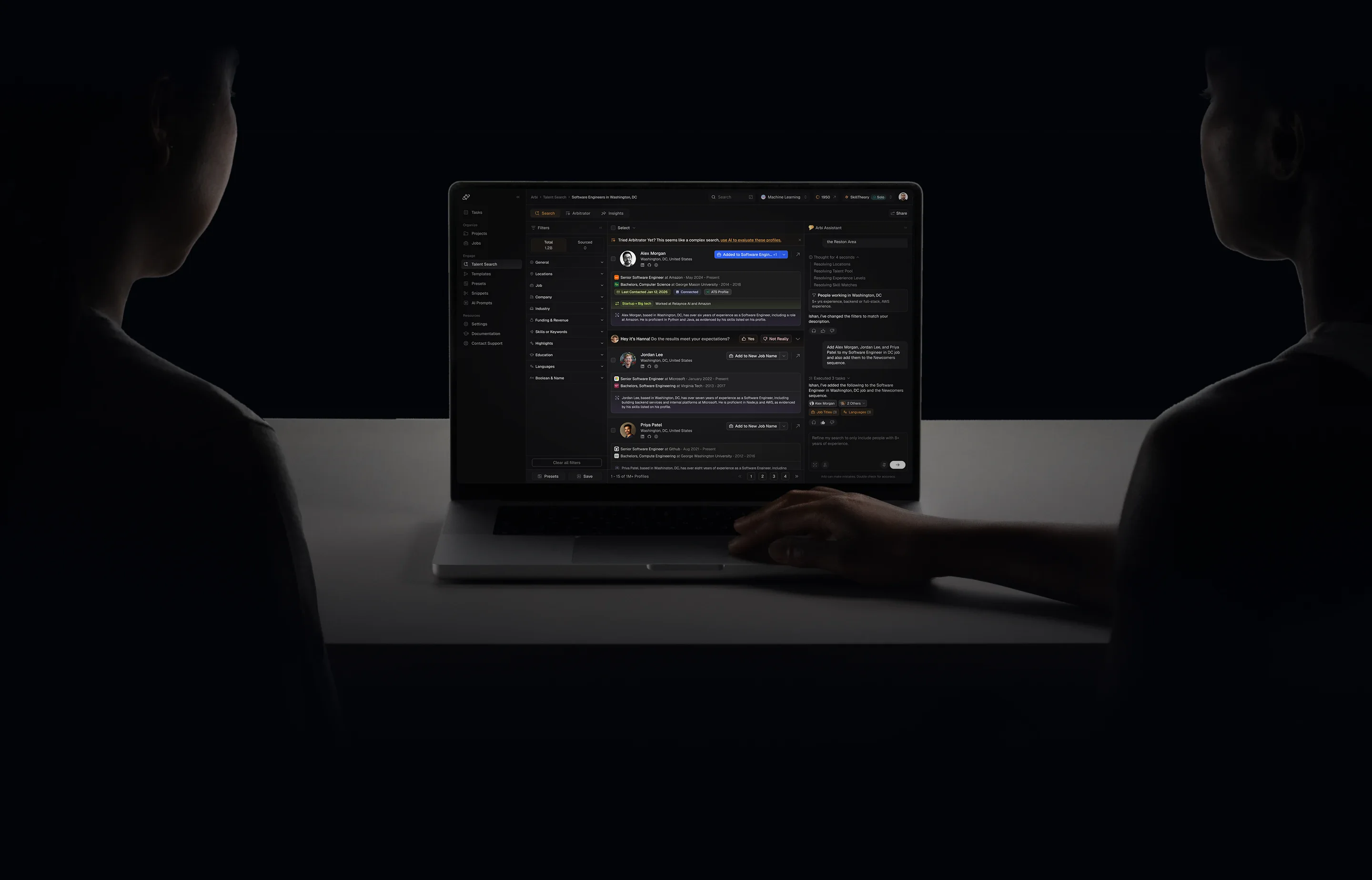
For teams evaluating how outreach fits into a broader sourcing strategy, neuroscale.ai's Arbi sourcing capabilities demonstrate how a unified platform can handle both candidate identification and engagement without requiring separate tool integrations.
Full-Funnel AI Recruiting Platforms vs. Point-Solution Stacks
The dominant advice in the recruiting software market is to build a stack of two to three specialized AI tools, each optimized for a specific stage of the hiring funnel. This approach has merit: best-of-breed tools often outperform generalist platforms on their core function, and modular stacks allow teams to swap components as better options emerge.
However, the point-solution approach creates integration debt that compounds over time. Each tool in your stack requires its own implementation, training, and maintenance. Data flows between systems through integrations that can break, lag, or lose context. Recruiters spend time toggling between interfaces rather than engaging with candidates. And when something goes wrong in the hiring process, diagnosing whether the issue originated in your sourcing tool, your screening tool, or your outreach tool becomes a forensic exercise.
Full-funnel AI recruiting platforms offer an alternative: a single system that handles sourcing, outreach, and evaluation in one auditable workflow. The trade-off is that you are betting on one vendor's ability to execute well across multiple functions, rather than selecting the best tool for each stage independently.
For teams considering this decision, understanding common recruiting tech stack problems clarifies the hidden costs of fragmentation. And for those leaning toward a modular approach, our guide on how to build a recruiting tech stack provides a framework for selecting and integrating tools strategically.
The right choice depends on your team's size, technical resources, and tolerance for complexity. Enterprise TA teams with dedicated ops support may thrive with a curated stack. Lean teams at startups or mid-market companies often find that a unified platform delivers faster time-to-value and lower total cost of ownership.
AI Recruiting Software Comparison Matrix
The following matrix compares leading AI recruiting platforms across the core evaluation criteria that matter most to talent acquisition leaders and HR tech evaluators.
| Platform | Primary Function | Best For | ATS Integration | Bias Mitigation | Pricing Model |
|---|---|---|---|---|---|
| HireEZ | Sourcing | Technical and specialized roles | Deep integrations with major ATS platforms | Diversity filters available | Per seat |
| SeekOut | Sourcing | Diversity hiring initiatives | Bidirectional sync with enterprise ATS | Demographic reporting and diversity sourcing | Per seat |
| Findem | Sourcing | Attribute-based talent discovery | API integrations with leading ATS | Explainable AI scoring | Custom pricing |
| Truffle | Screening | High-volume resume review | Integrates with common ATS platforms | Configurable scoring criteria | Per job or per hire |
| GoPerfect | Screening | Compliance-focused enterprises | GDPR and CCPA compliant workflows | Auditable decision logs | Custom pricing |
| Workable | Screening + ATS | All-in-one recruiting suite | Native ATS functionality | AI prioritization with historical data | Per seat or per job |
| Gem | Outreach | Passive candidate nurturing | CRM-style integration with ATS | Engagement analytics | Per seat |
| Paradox (Olivia) | Outreach | Automated scheduling at scale | Integrates with major ATS and calendars | Conversational AI with audit trails | Custom pricing |
| GoodTime | Outreach | Interview scheduling optimization | Calendar and ATS integrations | Interviewer load balancing | Per seat |
| Greenhouse | Full-funnel | Structured hiring processes | Native ATS with AI add-ons | Bias reduction features in workflows | Per seat |
| Arbi | Full-funnel | Unified sourcing, outreach, and evaluation | Single-system architecture | Auditable AI decisions | Transparent tier pricing |
This matrix provides a starting point for comparison, but the right tool depends on your specific workflow bottlenecks, existing tech stack, and team capacity. Use the evaluation criteria from the first section to weight each factor according to your priorities.
Find the Right AI Recruiting Software for Your Team
Selecting the best AI recruiting software requires matching the tool's strengths to your team's most pressing hiring challenges, not chasing feature lists or brand recognition.
If your primary bottleneck is building candidate pipelines for hard-to-fill roles, prioritize AI sourcing tools with strong multi-source aggregation and skills-based matching. If you are drowning in applications and cannot review them fast enough, AI screening tools that automate resume parsing and candidate ranking will deliver the fastest ROI. If your recruiters spend too much time on scheduling and follow-up, AI outreach tools that handle coordination and sequencing will free them to focus on high-value conversations.
For teams that experience friction across multiple stages of the funnel, or that lack the technical resources to maintain a multi-tool stack, full-funnel AI recruiting platforms offer a simpler path. The integration debt and context loss that come with point solutions can outweigh the marginal performance gains of best-of-breed tools, especially for lean teams that need to move fast.
Talent acquisition leaders evaluating AI recruiting platforms should also consider the total cost of ownership beyond licensing fees. Implementation time, training requirements, and ongoing maintenance all affect whether a tool delivers value or becomes shelfware. Our breakdown of the true cost of AI recruiting tools in 2026 provides a framework for calculating these hidden expenses.
If you are ready to explore a unified AI recruiting platform that collapses sourcing, outreach, and evaluation into a single system, view neuroscale.ai's pricing to see how Arbi fits your team's needs and budget.
Frequently Asked Questions
What is AI recruiting software and what does it actually do?
AI recruiting software uses machine learning and natural language processing to automate tasks across the hiring funnel, including sourcing candidates, screening resumes, scheduling interviews, and personalizing outreach. These tools analyze large volumes of candidate data faster than manual review, surface qualified applicants based on configurable criteria, and reduce repetitive administrative work for recruiters. The goal is to improve hiring efficiency and candidate quality, not to replace human judgment in final hiring decisions.
What's the difference between an ATS and AI recruiting software?
An applicant tracking system (ATS) is a database and workflow tool for managing candidates through your hiring process, while AI recruiting software adds intelligent automation on top of that workflow. An ATS stores applications, tracks candidate status, and facilitates collaboration among hiring teams. AI recruiting software actively sources candidates, scores and ranks applicants, automates outreach, and provides predictive insights. Many modern AI powered hiring platforms integrate with existing ATS systems, and some, like Greenhouse and Workable, combine both functions natively.
Which AI recruiting software is best for small businesses and startups?
Startups and small businesses benefit most from AI recruiting platforms that offer fast implementation, transparent pricing, and minimal technical overhead. Tools like Workable provide an all-in-one solution that combines ATS functionality with AI-assisted screening, reducing the need to manage multiple vendors. For teams without dedicated recruiting staff, platforms with strong outreach automation, like Paradox for scheduling or Gem for candidate nurturing, can help compete for talent against larger companies. Full-funnel platforms that collapse sourcing, screening, and outreach into one system also reduce complexity for lean teams.
Do I need an all-in-one AI recruiting platform or can I combine tools?
You can succeed with either approach, but the right choice depends on your team's resources and tolerance for integration complexity. Combining specialized tools lets you select best-of-breed solutions for each hiring stage, but creates integration debt, data fragmentation, and higher maintenance overhead. All-in-one AI recruiting platforms simplify workflows and reduce context loss between stages, but require you to trust one vendor across multiple functions. Teams with dedicated HR ops support often manage stacks effectively, while lean teams typically find unified platforms deliver faster time-to-value.
Is AI completely replacing recruiters?
AI is not replacing recruiters; it is augmenting their capabilities by automating repetitive tasks and surfacing better data for decision-making. AI recruiting tools handle high-volume screening, scheduling coordination, and initial outreach at scale, freeing recruiters to focus on relationship-building, candidate experience, and strategic hiring decisions. The human judgment required to assess culture fit, negotiate offers, and close candidates remains essential. The most effective recruiting teams use AI as decision-support, not as a replacement for human expertise.
What features should I look for when evaluating AI recruiting tools?
When evaluating AI recruitment tools, prioritize five core features: candidate matching accuracy that goes beyond keyword parsing, outreach automation with personalization and sequencing capabilities, bias mitigation features including explainable AI and demographic reporting, deep ATS integration that syncs data bidirectionally in real time, and transparent pricing that allows you to calculate true cost-per-hire. Secondary considerations include implementation timeline, training requirements, and the vendor's track record with companies of similar size and hiring volume.
Do recruiters use AI detectors to screen candidates?
Most recruiters do not use AI detectors to screen candidate-submitted materials like resumes or cover letters. The focus of AI in recruiting is on improving sourcing, screening, and engagement efficiency, not on detecting whether candidates used AI tools to prepare their applications. Some organizations may use plagiarism detection for specific assessments, but widespread use of AI detectors in recruiting workflows is not a current industry standard. Candidates should focus on accurately representing their skills and experience rather than worrying about AI detection in the application process.