The best AI recruiting platforms in 2026 include Arbi, Greenhouse, HireEZ, Paradox (Olivia), Eightfold, Gem, and Humanly—each offering distinct strengths across sourcing, screening, scheduling, and candidate engagement. These AI-powered hiring platforms go beyond traditional applicant tracking by using machine learning to automate repetitive tasks, surface qualified candidates faster, and reduce time-to-hire without sacrificing candidate quality. Choosing the right platform depends on your hiring volume, team size, integration requirements, and whether you need a point solution or a full-stack recruiting operating system.
For HR Directors managing high-volume hiring at mid-to-large companies, the priority is reducing manual screening time while improving the quality of candidates reaching the interview stage. Startup founders and lean HR teams need affordable AI recruitment tools that automate sourcing and engagement without requiring a dedicated recruiting function. This guide compares the leading AI recruiting software for 2026, explains how we evaluated each tool, and helps you identify the right fit for your team.
What Makes an AI Recruiting Platform Different from Traditional ATS?
An AI recruiting platform uses machine learning and natural language processing to actively source, screen, and engage candidates—rather than simply storing applications and tracking workflow stages like a traditional applicant tracking system. The distinction matters because legacy ATS tools were designed as databases with workflow automation bolted on, while genuine AI recruiting software makes predictive decisions that reduce manual effort at every stage of the hiring funnel.
Traditional ATS platforms require recruiters to manually review resumes, set up keyword filters, and manage candidate communications. AI-powered recruitment platforms automate these tasks by learning from historical hiring data, identifying patterns in successful hires, and surfacing candidates who match role requirements before a recruiter ever opens a profile. This shift moves recruiting teams from reactive processing to proactive talent acquisition.
The practical difference shows up in time-to-hire metrics and recruiter workload. An AI recruiter can screen hundreds of applications in minutes, rank candidates by fit, and initiate personalized outreach—tasks that would take a human recruiter hours or days. For a deeper breakdown of how these systems diverge from legacy tools, see our guide on what makes an AI recruiting platform different from traditional ATS.
AI recruiting platforms also integrate predictive analytics that traditional systems lack. They can forecast candidate drop-off risk, recommend optimal interview timing, and flag potential bias in job descriptions before they go live. These capabilities transform recruiting from an administrative function into a strategic advantage.
How We Evaluated the Best AI Recruiting Tools
We evaluated AI recruiting tools based on five criteria that matter most to hiring teams making platform decisions: core AI capabilities, integration depth, compliance posture, pricing transparency, and real-world use-case fit.
Core AI capabilities include sourcing automation, resume screening accuracy, candidate matching algorithms, and conversational AI for engagement. We prioritized platforms that demonstrate measurable improvements in time-to-hire and candidate quality rather than those that simply add AI branding to traditional features.
Integration depth measures how well each platform connects with existing HR infrastructure—HRIS systems, job boards, background check providers, and communication tools. A platform that requires manual data entry or creates workflow silos fails the integration test regardless of its AI sophistication.
Compliance posture evaluates how each tool handles data privacy regulations like GDPR and CCPA, as well as emerging AI hiring laws that require algorithmic transparency and bias auditing. Platforms with government-tested compliance frameworks received higher marks than those with vague policy statements.
Pricing transparency reflects whether vendors publish clear pricing tiers or require sales calls for basic cost information. We factored in total cost of ownership, including implementation fees, per-seat charges, and usage-based pricing that can inflate costs at scale. For a detailed breakdown of what these tools actually cost, see our analysis of the true cost of AI recruiting tools in 2026.
Use-case fit determines which platforms serve specific hiring contexts best—high-volume enterprise hiring, lean startup teams, agency recruiting, or specialized technical roles. No single platform excels at everything, so we assigned "best for" designations based on where each tool delivers the strongest ROI.
Best AI Recruiting Platforms for 2026 Compared
The leading AI recruiting platforms for 2026 fall into distinct categories based on their primary strengths: full-stack recruiting operating systems, specialized sourcing tools, screening and assessment platforms, and conversational AI solutions.
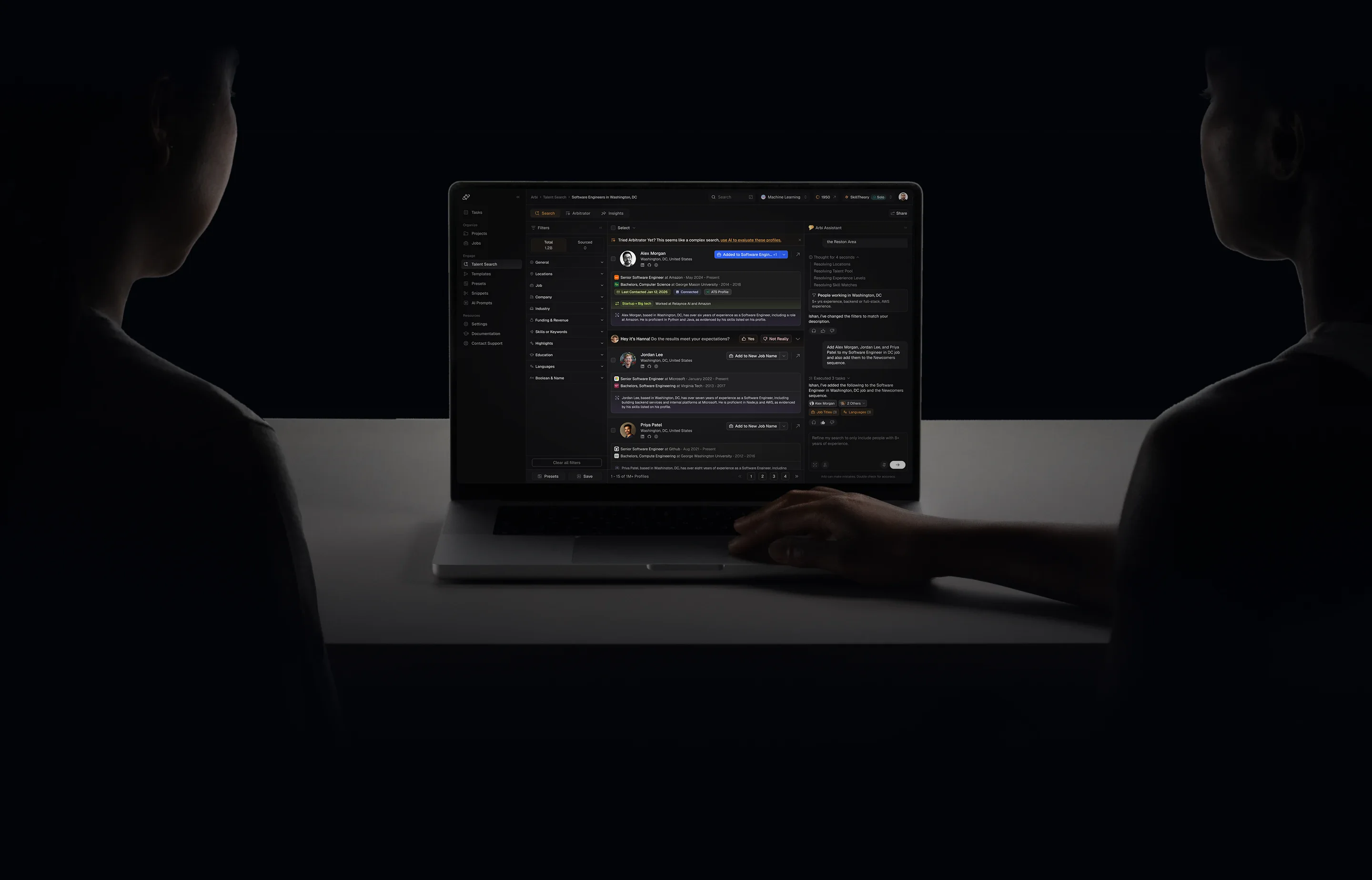
Arbi by Neuroscale AI stands out as a full-stack, government-tested recruiting OS that handles sourcing, screening, scheduling, and candidate engagement within a single platform. Unlike point solutions that require integration with multiple vendors, Arbi provides end-to-end automation with enterprise-grade compliance built in. It serves as the benchmark for this comparison because it addresses the fragmentation problem that plagues most recruiting tech stacks.
Greenhouse remains a dominant player for scaling and enterprise teams, combining robust ATS functionality with AI-powered sourcing and analytics. Its strength lies in structured hiring workflows and deep integration ecosystem, though it functions more as an enhanced ATS than a pure AI recruiting platform.
HireEZ specializes in AI-powered sourcing, using machine learning to search across multiple talent pools and identify passive candidates who match role requirements. It excels for teams that need to expand their candidate pipeline beyond inbound applications.
Paradox (Olivia) leads in conversational AI for candidate engagement, automating scheduling, screening questions, and FAQ responses through a chatbot interface. High-volume hiring teams use it to reduce no-shows and keep candidates engaged throughout the process.
Eightfold offers a talent intelligence platform that uses AI to match candidates to roles based on skills and career trajectory rather than keyword matching. Its strength is internal mobility and workforce planning alongside external recruiting.
Gem combines CRM functionality with AI-powered outreach automation, helping recruiters manage candidate relationships and track engagement across multiple touchpoints. It works best for teams that prioritize relationship-driven recruiting.
Humanly focuses on high-volume hiring automation, using conversational AI to screen candidates and schedule interviews at scale. It targets industries like retail, hospitality, and healthcare where speed and volume matter most.
For teams evaluating sourcing capabilities specifically, our top talent sourcing platforms comparison provides additional depth on how these tools stack up for candidate discovery.
| Platform | Best For | Primary Strength | Integration Depth | Pricing Model |
|---|---|---|---|---|
| Arbi | Full-stack enterprise hiring | End-to-end automation with compliance | Native integrations | Tiered subscription |
| Greenhouse | Scaling teams with structured hiring | ATS + AI analytics | Extensive ecosystem | Per-employee pricing |
| HireEZ | Passive candidate sourcing | Multi-source talent search | CRM and ATS integrations | Usage-based |
| Paradox (Olivia) | High-volume candidate engagement | Conversational AI scheduling | ATS integrations | Per-hire or subscription |
| Eightfold | Skills-based matching and mobility | Talent intelligence | HRIS integrations | Enterprise contracts |
| Gem | Relationship-driven recruiting | CRM + outreach automation | Email and ATS integrations | Per-seat pricing |
| Humanly | High-volume screening | Conversational AI screening | ATS integrations | Volume-based |
How to Choose the Right AI-Powered Hiring Platform for Your Team
Choosing the right AI-powered hiring platform starts with understanding your hiring volume, team structure, and existing technology stack—not with feature comparisons. The best platform for an enterprise HR team managing thousands of requisitions differs fundamentally from the right choice for a startup founder hiring their first ten employees.
For high-volume enterprise hiring teams, prioritize platforms that offer end-to-end automation, robust compliance frameworks, and deep integration with existing HRIS and ATS systems. Fragmented point solutions create workflow gaps and data silos that negate efficiency gains. A full-stack platform like Arbi reduces vendor management overhead while maintaining consistent candidate experience across all touchpoints.
For startups and small teams, affordability and ease of implementation matter more than feature depth. Look for platforms with transparent pricing, minimal setup requirements, and automation that replaces manual tasks without requiring a dedicated recruiting function. Conversational AI tools that handle scheduling and screening can deliver immediate ROI without significant investment.
For agency recruiters and talent acquisition specialists, CRM functionality and outreach automation drive productivity gains. Platforms that track candidate relationships across multiple clients and automate personalized engagement help individual recruiters manage larger pipelines without sacrificing quality.
Consider how any new platform fits into your broader recruiting infrastructure. Adding another point solution to an already fragmented stack often creates more problems than it solves. Our guide on how to build a recruiting tech stack explains how to evaluate platform fit within your existing systems.
Ask vendors specific questions about implementation timelines, training requirements, and ongoing support. A platform that promises powerful AI capabilities but requires months of configuration and dedicated technical resources may not deliver value for teams that need immediate results.
Key Features to Look for in AI Recruitment Software
The most important features in AI recruitment software address the core pain points that slow down hiring: manual resume screening, inconsistent candidate communication, scheduling friction, and lack of visibility into pipeline health.
AI-powered sourcing automates candidate discovery by searching across job boards, professional networks, and proprietary databases to identify qualified candidates who match role requirements. The best sourcing tools go beyond keyword matching to assess skills, experience patterns, and career trajectory. Neuroscale.ai's sourcing capabilities demonstrate how AI can surface passive candidates that traditional methods miss.
Automated screening uses machine learning to evaluate applications against role requirements, ranking candidates by fit and flagging potential concerns before human review. This feature delivers the largest time savings for high-volume hiring teams. Effective screening tools reduce time-to-shortlist from days to hours while maintaining quality standards.
Conversational AI and chatbots handle candidate communication at scale—answering FAQs, collecting screening information, and scheduling interviews without recruiter intervention. These tools reduce candidate drop-off by providing immediate responses and keeping applicants engaged throughout the process.
Predictive analytics provide visibility into pipeline health, forecast time-to-fill, and identify bottlenecks before they impact hiring outcomes. Advanced platforms use historical data to recommend process improvements and flag roles at risk of extended vacancy.
Bias detection and compliance tools audit job descriptions, screening criteria, and hiring patterns for potential bias. With increasing regulatory scrutiny on AI in hiring, these features protect organizations from legal risk while promoting equitable hiring practices.
Integration capabilities determine whether a platform enhances your existing workflow or creates additional friction. Look for native integrations with your ATS, HRIS, calendar systems, and communication tools. Platforms that require manual data transfer or custom API work add hidden costs and implementation delays.
Many recruiting teams struggle with fragmented tools that don't communicate effectively. Our analysis of common recruiting tech stack problems explains why integration depth matters as much as individual feature quality.
Start Hiring Smarter with neuroscale.ai
Arbi by neuroscale.ai delivers the full-stack AI recruiting capabilities that enterprise teams need without the fragmentation of point solutions. Built with government-tested compliance frameworks and enterprise-grade security, Arbi handles sourcing, screening, scheduling, and candidate engagement within a single platform.
For HR Directors accountable for hiring outcomes, Arbi reduces time-to-hire while improving candidate quality through AI-powered matching that learns from your organization's successful hires. For startup teams scaling without dedicated recruiting resources, it provides automation that replaces manual processes without requiring technical expertise to implement.
Explore Arbi's sourcing capabilities to see how AI-powered candidate discovery works in practice. Review our pricing page to understand total cost of ownership and compare against the fragmented vendor costs of point solutions.
The best AI recruiting platforms in 2026 don't just automate existing processes—they transform how organizations identify, engage, and hire talent. Arbi represents the next generation of recruiting technology: a unified platform that delivers measurable results without the complexity of managing multiple vendors.
Frequently Asked Questions
What is an AI recruiting platform?
An AI recruiting platform is software that uses machine learning and natural language processing to automate hiring tasks like sourcing candidates, screening resumes, scheduling interviews, and engaging applicants. Unlike traditional applicant tracking systems that function primarily as databases, AI recruiting platforms make predictive decisions that reduce manual recruiter effort and improve hiring outcomes.
Which AI recruiting platform is best for enterprise hiring teams?
Arbi is the best AI recruiting platform for enterprise hiring teams because it provides full-stack automation with government-tested compliance frameworks. Enterprise teams benefit from end-to-end capabilities that eliminate the integration challenges and data silos created by point solutions. Greenhouse and Eightfold also serve enterprise needs, particularly for teams with established ATS infrastructure.
What are the best AI recruiting platforms for small teams and startups?
The best AI recruiting platforms for small teams and startups are those with transparent pricing, minimal setup requirements, and automation that delivers immediate value without dedicated recruiting staff. Paradox (Olivia) and Humanly offer conversational AI that handles screening and scheduling at accessible price points. Arbi provides full-stack capabilities with tiered pricing that scales with team size.
What are the best ways to use AI in recruiting?
The best ways to use AI in recruiting include automating resume screening to reduce time-to-shortlist, using conversational AI to handle candidate communication and scheduling, leveraging predictive analytics to identify pipeline bottlenecks, and deploying AI-powered sourcing to discover passive candidates. These applications deliver measurable ROI by reducing manual tasks while improving candidate quality and experience.
Do AI recruiting platforms replace an ATS?
Some AI recruiting platforms replace an ATS entirely by providing applicant tracking functionality alongside AI capabilities, while others integrate with existing ATS systems as specialized point solutions. Full-stack platforms like Arbi can serve as a complete recruiting operating system. Specialized tools like HireEZ or Paradox typically complement rather than replace existing ATS infrastructure.
What features should I look for in an AI recruiting platform?
Look for AI-powered sourcing that discovers candidates beyond inbound applications, automated screening that ranks candidates by fit, conversational AI for candidate engagement, predictive analytics for pipeline visibility, bias detection tools for compliance, and deep integrations with your existing HR technology stack. Prioritize features that address your specific hiring pain points rather than chasing comprehensive feature lists.
How much do AI recruiting platforms cost?
AI recruiting platform costs vary widely based on pricing model and feature scope. Per-seat pricing typically ranges from $100 to $500 per user per month. Usage-based models charge per hire or per candidate screened. Enterprise contracts often require custom quotes based on hiring volume and feature requirements. Factor in implementation costs, training, and integration work when calculating total cost of ownership.