Strategic Overview
Recruiting in 2026 is increasingly defined by skills-first strategies and AI-powered sourcing platforms that scale global outreach and sharpen candidate insight. The shift from résumé-based filtering to skills mapping has expanded accessible talent pools by up to fivefold while improving representation diversity by around 16%. For talent acquisition teams, the question is no longer if to use an AI sourcing platform—but which one best fits hiring goals, integration needs, and compliance standards.
A talent sourcing platform is an advanced recruiting system that identifies, engages, and manages potential candidates across multiple channels. Modern solutions merge AI search, workflow automation, and continuous data enrichment to help recruiters reach passive talent and measure results at scale. Below is a ranked analysis of the 12 platforms defining the sourcing landscape in 2026.
Arbi by Neuroscale AI
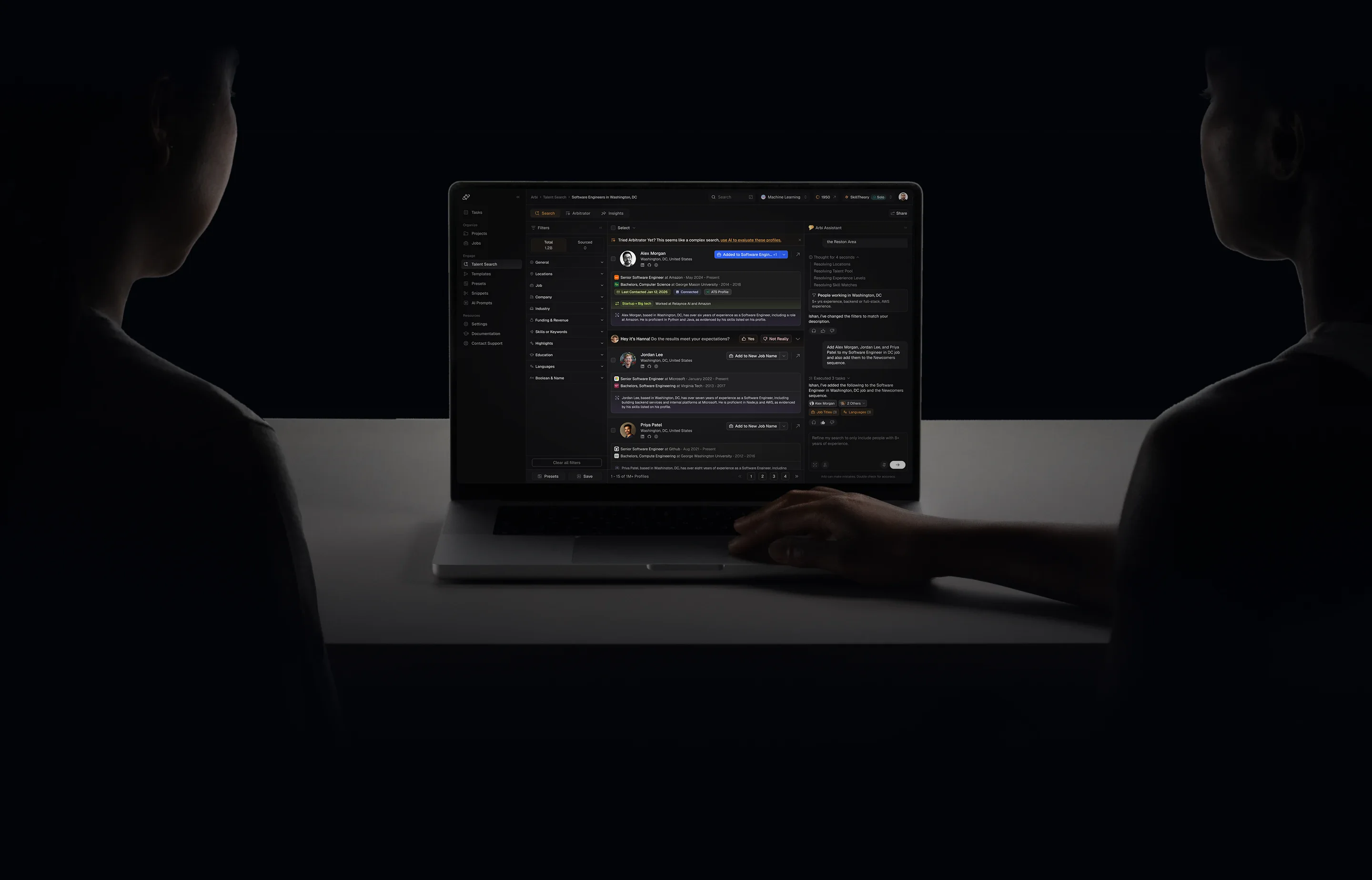
Arbi, from Neuroscale AI, sets the benchmark for enterprise-grade sourcing built on scientific precision. It provides access to over 900 million global candidate profiles drawn from verified public, proprietary, and partner datasets. Recruiters can automate personalized outreach sequences, apply AI-powered screening to model skills-to-role fit at scale, and integrate seamlessly with 50+ systems—including Greenhouse, Lever, Gmail, Outlook, and Workday.
Arbi is engineered for high performance and enterprise compliance, backed by SOC 2 Type 2, ISO 27001+, and full GDPR/CCPA alignment. Its AI screening agents evaluate candidates across competencies, reducing manual review time and bias while improving interview throughput. For government and regulated industries, Arbi’s security foundation—SSO, SCIM, audit logs, and on-premise options—provides the assurance required for sensitive environments.
Best for: Enterprises prioritizing automation, precision sourcing, and diversity pipeline expansion through measurable, data-driven recruiting.
PeopleGPT by Juicebox
Juicebox combines AI-native search with accessible pricing and flexible configuration. Recruiters can use natural-language prompts—for example, “engineers with Kubernetes contributions from Asia-Pacific”—to instantly access a dataset of over 800 million profiles from public networks, conference lists, and technical publications. Built-in outreach and autonomous sourcing agents reduce manual Boolean logic and can be extended as custom modules.
Best for: Agile startups and fast-growth companies seeking a self-serve AI sourcing toolkit with broad reach and rapid onboarding.
SeekOut
SeekOut leads in passive talent discovery and diversity-based AI search. With more than 800 million indexed profiles, it offers contextual PeopleGPT search and automatic enrichment of candidate data. Its autonomous sourcing agents run continuously, surfacing new profiles while omitting duplicates or previously contacted talent.
Best for: Established talent teams seeking deep insights across technical, diversity-focused, or hard-to-fill pipelines.
TheHireHub.AI
TheHireHub.AI emphasizes semantic search spanning more than 200 data sources with enterprise-grade interoperability. It fits well in environments requiring advanced analytics, governance, and cross-system connectivity. Pricing aligns with its premium positioning, supported by robust automation and reporting functionality.
Best for: Organizations managing complex recruiting operations with strict integration and compliance requirements.
hireEZ
hireEZ supports high-volume sourcing with strong compliance controls, ideal for regulated sectors such as healthcare or finance. Its 220 million candidate profiles and analytics streamline requisition-heavy recruiting cycles. Diversity analytics, workforce forecasting, and role segmentation are built alongside SOC and EEOC compliance frameworks.
Best for: Enterprise teams needing scalable sourcing and detailed compliance verification.
Gem
Gem unifies sourcing, CRM, and analytics within a single framework designed for long-term candidate relationship management. Recruiters can automate outreach sequences, track every touchpoint, and measure engagement metrics throughout the funnel. Its Chrome extension sits on top of public professional profiles, simplifying contact enrichment and pipeline updates.
Best for: Teams focused on consistent engagement and nurturing relationships using data-backed outreach.
AmazingHiring
AmazingHiring stands out in technology recruiting through analysis of developer data from GitHub, Stack Overflow, and similar technical communities. Recruiters gain contextualized insights—from project history to certifications—supporting accurate shortlists without manual search work.
Best for: Engineering and product teams prioritizing verified technical capability and open-source activity analysis.
iCIMS
iCIMS is a leading ATS and global talent cloud platform trusted by large enterprises. Beyond sourcing, it merges CRM, career site management, and analytics in one architecture. Implementation often requires sizable commitment, and full deployments can exceed six figures, but the unified system benefits teams handling multinational compliance and internal staffing complexity.
Best for: Global enterprises needing an extensive, integrated talent suite supporting both sourcing and governance.
SmartRecruiters
SmartRecruiters provides global recruiting infrastructure with modular marketplace integrations. Teams can configure end-to-end recruiting processes—posting, evaluating, and onboarding—while maintaining flexibility across teams and regions. Typical entry-level contracts start near $50,000 annually.
Best for: Medium to large organizations operating across multiple geographies that value extensibility and centralized visibility.
Beamery
Beamery positions itself as a “talent operating system,” connecting CRM, sourcing, and workforce planning via one data layer. It helps employers map adjacent skills, enabling internal mobility and workforce redeployment across regional divisions.
Best for: Enterprises emphasizing diversity, internal mobility, and long-range skills planning.
Dice
For North American technology recruiting, Dice remains a specialized, cost-efficient option. It provides detailed visibility into IT and engineering segments, with verified profiles and high-response job postings.
Best for: Smaller agencies or internal recruiting teams targeting niche IT and engineering talent pools.
Entelo
Entelo applies predictive analytics to flag passive candidates most likely to seek new roles soon. By analyzing career timelines, online signals, and activity levels, it enables recruiters to time outreach with higher conversion probability.
Best for: Data-driven recruiting teams optimizing outreach strategy and lead quality through predictive insights.
How to Choose the Right Talent Sourcing Platform
Choosing the right system starts with addressing your recruiting bottlenecks—whether limited candidate coverage, slow outreach, or compliance friction.
-
Define priorities: Identify where current processes slow down, such as narrow pools or manual sourcing.
-
Test integrations: Verify functionality with current ATS, CRM, and communication tools.
-
Verify compliance: Confirm adherence to SOC 2, ISO 27001, and GDPR standards.
-
Run pilot roles: Measure productivity impact before scaling organization-wide.
Evaluating on these criteria helps align selection with company size, hiring velocity, and regulatory requirements.
Key Features to Compare Across Platforms
When evaluating solutions, focus on the capabilities that most directly influence sourcing outcomes:
-
AI-powered search and match: Algorithms map skills and experience patterns to role criteria.
-
Autonomous agents: AI-powered bots that continually surface new candidates as pipelines evolve.
-
Multi-channel outreach: Built-in sequencing for email, social, and SMS at scale.
-
Talent data refresh and enrichment: Ongoing updates from public and private signals such as GitHub or professional directories.
A concise comparison table can reveal which platforms provide the greatest operational and compliance return for your environment.
Integrations with ATS and Communication Tools
Integrations determine how fast insights turn into hires. Platforms like Arbi, Juicebox, SeekOut, and hireEZ offer direct connectors to Greenhouse, Lever, and Workday, plus Gmail and Outlook synchronization. This interoperability reduces manual data transfer and keeps recruiters operating within a unified, intelligent workspace.
Example integrations:
-
ATS: Greenhouse, iCIMS, SmartRecruiters, Workday
-
Communication: Gmail, Outlook, Slack
-
HRIS/CRM: Workday, Salesforce
Pricing Models and Total Cost of Ownership
Assessing price means including all cost factors—not just subscriptions. The total cost of ownership (TCO) encompasses license fees, setup effort, necessary modules, users, and support.
Examples:
-
iCIMS: Over $100K/year for complete enterprise suite.
-
SmartRecruiters: Starts near $50K/year.
-
Juicebox: Flexible self-serve tiered pricing.
-
Arbi: Flexbible self-serve tiered pricing starting at only $79 monthly.
Evaluating which modules—such as AI search or sequencing—are core versus optional avoids surprises during renewal.
Practical Tips for Piloting Talent Sourcing Platforms
To verify ROI before full implementation:
-
Start small: Pilot on a few pivotal roles.
-
Measure outcomes: Track reply rates, interview throughput, and candidate quality.
-
Assess usability: Confirm recruiters integrate platform features naturally into daily workflows.
-
Validate compliance: Ensure data handling aligns with internal and contractual obligations.
This approach enables objective, data-backed adoption decisions.
Frequently Asked Questions
What are the main differences between an ATS and a talent sourcing platform?
An ATS manages applicant workflows and internal approvals, while a sourcing platform—like Arbi by Neuroscale AI—proactively finds and engages candidates before they apply.
Which features best enhance diversity and inclusion?
AI-driven skill matching and semantic search reduce bias and expand representation in sourcing pipelines.
How can recruiters gauge a platform’s effectiveness?
Measure reply and open rates, quality of surfaced candidates, and improvements in time-to-interview metrics.
What compliance standards should organizations verify?
Look for certifications such as SOC 2, GDPR, and ISO 27001, plus solutions with built-in SSO, SCIM, and audit logging.
How do AI and automation improve sourcing efficiency?
They analyze vast candidate datasets, automate sequenced outreach, and sustain active talent pipelines faster than manual effort.