The way recruiting teams locate, interact with, and assess talent has been completely transformed by artificial intelligence. A new generation of AI recruiting tools has surfaced in recent years to assist teams in operating at scale, moving more quickly, and working more intelligently.
Nowadays, a lot of startups, businesses, and staffing companies employ tools like Juicebox, HireEZ, Gem, Neuroscale, and Findem. Each platform offers unique advantages in CRM, engagement, talent analytics, and sourcing.
But as adoption grows, so does a critical question:
Are recruiting platforms simply helping teams manage hiring, or are they actually running it?
This guide breaks down the leading AI recruiting platforms in 2026, how they're used today, where they perform well, and where many teams are beginning to look beyond tools toward systems that execute hiring end to end.
What Is an AI Recruiting Platform?
An AI recruiting platform is software that applies artificial intelligence to parts of the hiring lifecycle, such as:
- Candidate sourcing and search
- Talent intelligence and data enrichment
- Outreach and engagement automation
- Resume screening and candidate evaluation
The best platforms combine several of these capabilities to help recruiting teams work faster and smarter.
Leading AI Recruiting Platforms in 2026
Juicebox Recruiting Platform
Juicebox is best known as an AI-powered sourcing and talent discovery platform. It focuses on helping recruiting teams search large candidate datasets, surface relevant profiles, and generate lead lists faster than traditional sourcing methods.
Core capabilities:
- Candidate discovery
- AI-assisted search
- Market mapping
Best for: Teams that deal with front-end sourcing, building outbound candidate lists, and identifying hard-to-find profiles.
Limitations: Teams often encounter challenges with accurate candidate evaluation, hiring workflow execution, and interview automation. While Juicebox excels at making finding people faster, it's less commonly used to manage or execute what happens after candidates are identified.
In practice, Juicebox is a strong sourcing layer but doesn't provide end-to-end automation.
HireEZ AI Recruiting Platform
HireEZ is positioned as a sourcing and talent intelligence platform built to help recruiting teams uncover, enrich, and organize candidate data across multiple sources. Its core strength lies in aggregating talent data, enhancing profiles with contact information, and supporting outbound recruiting workflows at scale.
Core capabilities:
- Multi-source candidate search
- AI-assisted sourcing
- Contact data enrichment
- Talent mapping
Best for: Talent research and pipeline development, especially when teams need to rediscover candidates or expand sourcing reach beyond traditional channels.
Limitations: Teams frequently encounter boundaries when it comes to automated candidate evaluation, orchestrating hiring workflows, and managing interview flows. While HireEZ helps surface and organize talent, it stops short of owning downstream execution or hiring outcomes.
In practice, HireEZ is most effective as a sourcing and intelligence layer. It strengthens access to candidate data and supports recruiter productivity, rather than serving as a system that automates the full hiring process end to end.
Gem Recruiting CRM
Gem is best known as a recruiting CRM and engagement platform designed to help teams manage candidate relationships over time. It integrates with existing ATS systems and focuses on outbound sequencing, candidate engagement, and pipeline visibility.
Core capabilities:
- Organize talent pools
- Run email and social outreach
- Nurture candidates across roles
- Track recruiting activity and engagement metrics
Best for: Relationship management and long-term pipeline development.
Limitations: Gem has clear boundaries when it comes to automated decision-making, candidate evaluation, and hiring execution. While it supports recruiting workflows, it does not own interview scheduling or end-to-end hiring operations.
In practice, Gem is meant to structure and engage talent pipelines, not to automate the hiring process itself.
Findem Talent Platform
Findem positions itself as a talent intelligence platform that combines sourcing, CRM functionality, and analytics to help teams better understand and segment talent markets. Its approach emphasizes people data, workforce insights, and advanced filtering to surface candidates based on experience, background, and inferred attributes.
Core capabilities:
- Strategic talent mapping
- Pipeline analysis
- Diversity insights
- Sourcing across large candidate populations
Best for: Organizations that want a clearer picture of where talent exists and how pipelines are evolving over time.
Limitations: Teams tend to encounter boundaries in downstream execution. Findem does not focus on automated candidate evaluation, interview orchestration, or owning hiring workflows end to end. While it provides strong intelligence and visibility, execution still relies heavily on recruiters and external systems.
As a result, Findem is commonly used as a data and insights layer within recruiting teams, rather than as a system designed to automate hiring operations from start to finish.
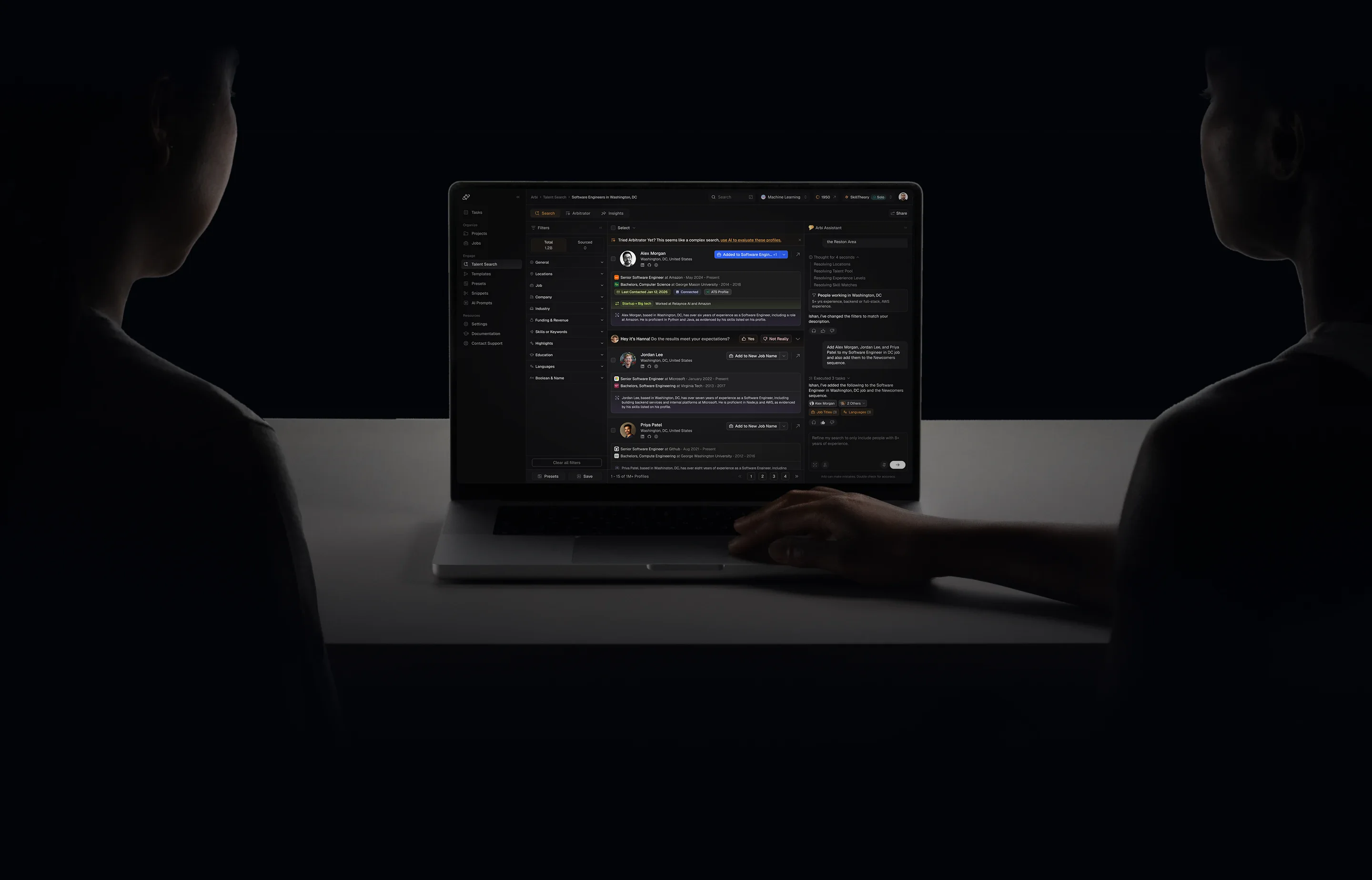
Arbi by Neuroscale AI: From Recruiting Tools to Hiring Execution
Neuroscale AI is built as a hiring execution platform, designed to automate and run hiring workflows rather than support individual recruiting tasks.
Instead of focusing solely on sourcing, CRM, or engagement, Neuroscale connects evaluation, decisioning, outreach, and coordination into a single operational system.
Core capabilities:
- Automated candidate evaluation and prioritization
- Multi-step hiring workflow automation
- Dual LLM architecture (designed to improve evaluation quality and reduce bias)
- Automated outreach and scheduling after initial screening
- Bias-aware decisioning frameworks
Best for: Teams that want hiring processes to operate continuously rather than relying on manual review and coordination.
What makes it different: Where Neuroscale differs most from traditional recruiting platforms is in execution ownership. The system is designed to handle automated evaluation, decisioning, and workflow orchestration end to end, rather than stopping at candidate discovery or engagement.
As a result, Neuroscale functions as hiring infrastructure: an operational layer that turns hiring intent into consistent, bias-aware execution at scale.
So, What Is the Best AI Recruiting Platform?
The best platform depends on whether a team needs sourcing, CRM, analytics, screening, or full hiring execution.
Many teams now evaluate platforms based on how much of hiring they can automate end to end, not just how well they support individual tasks.
If your primary need is:
- Sourcing and discovery → Juicebox, HireEZ
- Relationship management and pipeline nurture → Gem
- Talent intelligence and market insights → Findem
- End-to-end hiring execution and automation → Neuroscale
There's no universal "best." But there is increasing clarity about what each platform is designed to do, and what it's not.
Final Thoughts
AI recruiting platforms in 2026 are no longer just about speed or data access. They are increasingly judged on their ability to operationalize hiring:
- Reduce manual work
- Improve decision quality
- Turn recruiting into a scalable system
As the market evolves, teams are moving beyond stacks of tools toward integrated hiring engines that connect intelligence, execution, and outcomes.
The question is no longer "Which tool should we add?"
It's "Which system can actually run hiring for us?"
See the Difference
Want to understand what it looks like when hiring runs as infrastructure, not just a collection of tools?
Book a walkthrough with Neuroscale to see how Arbi automates evaluation, decisioning, and workflow execution end to end: [email protected]
No lengthy demos, no sales theater; just a clear look at what hiring execution actually means.
About Neuroscale AI: Neuroscale builds Arbi, an AI-powered hiring execution platform designed to automate workflows from evaluation through scheduling. The company believes recruiting should operate as infrastructure, not a manual process supported by tools. Learn more at neuroscale.ai.