Oxford researchers just found something surprising: only 1% of recent layoffs are actually caused by AI, but if you asked the average person on the street, they'd probably guess it's closer to 50%.
CNBC recently covered what they called the "AI scapegoat" phenomenon. Headlines scream about AI replacing workers. Professional-network feeds overflow with anxiety about automation. Job seekers worry that AI will screen them out before a human ever sees their resume.
But the data tells a different story.
The gap between what AI is actually doing (affecting 1% of layoffs) and what people think it's doing (taking all the jobs) isn't just a perception problem. It's creating real challenges for the people trying to use AI responsibly, particularly talent acquisition teams.
Here's what's really happening, why the perception gap exists, and what it means for the future of hiring.
The Data: AI's Actual Impact vs. Perceived Impact
Let's start with the facts.
According to recent research from Oxford University, AI automation accounts for approximately 1% of recent job losses. Not 10%. Not 25%. One percent.
Meanwhile, the World Economic Forum's 2025 Future of Jobs Report shows that while 40% of employers expect AI to change their workforce composition, the primary drivers of restructuring remain:
- Economic slowdowns and market corrections
- Shifts in consumer demand
- Supply chain reorganization
- Legacy infrastructure modernization
- Post-pandemic workforce rebalancing
AI shows up in these transformations, but it's rarely the sole, or even primary, cause.
What the Perception Gap Means for Talent Acquisition
Here's where the gap between perception and reality creates real problems: especially for TA teams.
Challenge 1: Candidate Skepticism
When candidates hear "we use AI in our hiring process," many assume the worst:
- "A robot is screening me out before a human sees my resume."
- "The AI is biased and I won't get a fair shot."
- "They're replacing recruiters, what does that say about how they value people?"
Even when companies are using AI to improve fairness, speed up processes, or surface overlooked candidates, the perception creates resistance. TA teams find themselves defending tools before they can explain the benefits.
Challenge 2: Internal Resistance
Talent teams considering AI adoption face pushback from within their own organizations.
HR colleagues worry: "Are we next?"
Recruiters ask: "Is this the first step toward replacing us?"
Hiring managers question: "Can we trust this?"
The perception that "AI = job elimination" makes it harder to build internal buy-in—even for tools designed to make teams more effective, not smaller.
Challenge 3: The Trust Deficit
Perhaps most challenging: the perception gap erodes trust in AI tools across the board.
When people believe AI is responsible for massive job losses (even though the data says otherwise), they become skeptical of all AI applications, including the ones that could genuinely help.
Tools that provide transparent reasoning, reduce bias, or surface overlooked candidates get lumped into the same category as opaque automation that genuinely does replace workers. The nuance gets lost.
What the Perception Gap Means for Talent Acquisition
Here's what often gets missed in the "AI is taking jobs" narrative:
There's a massive difference between AI that replaces human judgment and AI that amplifies it.
Replacement AI:
- Makes final decisions without human review
- Can't explain its reasoning
- Optimizes purely for speed or cost reduction
- Treats hiring as a purely mechanical process
Amplification AI:
- Surfaces candidates for human review
- Shows its reasoning transparently
- Helps humans make better, fairer decisions
- Treats hiring as a human process enhanced by technology
The problem is that public perception, and much of the anxiety around AI in hiring, doesn't distinguish between these approaches. When talent teams say "we use AI," candidates hear "replacement" even if the reality is "amplification."
What Transparency Actually Looks Like
If the perception gap is about trust, then closing it requires transparency. Not transparency as a buzzword. Transparency as a practice. Transparent AI in hiring means:
1. Explainability (Every recommendation comes with reasoning):
- Which skills matched (with evidence from the resume)
- What gaps exist (and whether they matter)
- Why Candidate A ranked higher than Candidate B
No black boxes. No mystery scores. No "the algorithm said so."
2. Human Control (AI recommends. Humans decide.)
The technology surfaces candidates, flags patterns, and provides evidence, but a person always makes the final call, considering context the AI might miss.
3. Bias Monitoring (Track outcomes, not just inputs)
- Selection rates across demographic groups
- Patterns that might indicate unfair filtering
- Flags when something doesn't look right
The goal isn't "perfect AI" (that doesn't exist). It's AI that helps humans spot and correct for bias.
4. Clarity About What AI Does (and Doesn't Do) (Tell candidates exactly how AI is used):
- "We use AI to help us review applications more consistently"
- "AI surfaces candidates we might have missed, but a recruiter reviews every recommendation"
- "Here's how the AI evaluated your application, and here's why we're moving forward (or not)"
Transparency builds trust. Opacity destroys it.
The Real Question Isn't "Will AI Take Jobs?"
The Oxford data shows that AI's current impact on job losses is minimal. But the perception gap reveals something more important:
The question isn't "Will AI take jobs?" It's "How will we choose to use AI?"
Organizations have options:
Option 1: Use AI to reduce headcount
- Optimize for cost savings and speed
- Replace human judgment with automation
- Treat hiring as a purely mechanical process
Option 2: Use AI to improve outcomes
- Find candidates traditional processes miss
- Make decisions more consistent and defensible
- Give teams better information to make better choices
The technology can do both. The difference is intent.
What Talent Leaders Can Do Right Now
If the perception gap is creating challenges for talent teams, here's how to navigate it:
1. Be Explicit About How AI Is Used
Don't hide behind vague language like "AI-powered platform" or "advanced algorithms." Instead, tell candidates and employees exactly what the AI does:
- "We use AI to help us search across all past applicants, not just current ones"
- "AI flags candidates with adjacent skills we might have overlooked"
- "Every AI recommendation is reviewed by a recruiter who makes the final decision"
Specificity builds trust. Vagueness confirms fears.
2. Show Your Work
When AI influences a decision, make the reasoning visible, at least internally, and ideally to candidates too. If someone doesn't move forward, can the recruiter explain why in concrete terms? If they do move forward, can the hiring team see what evidence supported that decision? Transparent reasoning protects against bias and builds confidence in the process.
3. Measure and Monitor
Track not just efficiency metrics (time-to-hire, cost-per-hire) but fairness metrics:
- Are selection rates consistent across demographic groups?
- Are candidates with non-traditional backgrounds getting fair consideration?
- Is the AI surfacing diverse talent, or reinforcing historical patterns?
Regular monitoring catches problems early, and demonstrates commitment to responsible AI use.
4. Engage Your Team in the Process
Don't roll out AI tools without involving the people who'll use them.
Ask recruiters:
- What's working? What's not?
- Where does the AI help? Where does it get in the way?
- What would make you trust these recommendations more?
When teams feel like partners in adoption (not subjects of replacement), resistance decreases and adoption improves.
Where Neuroscale Stands on the Perception Gap
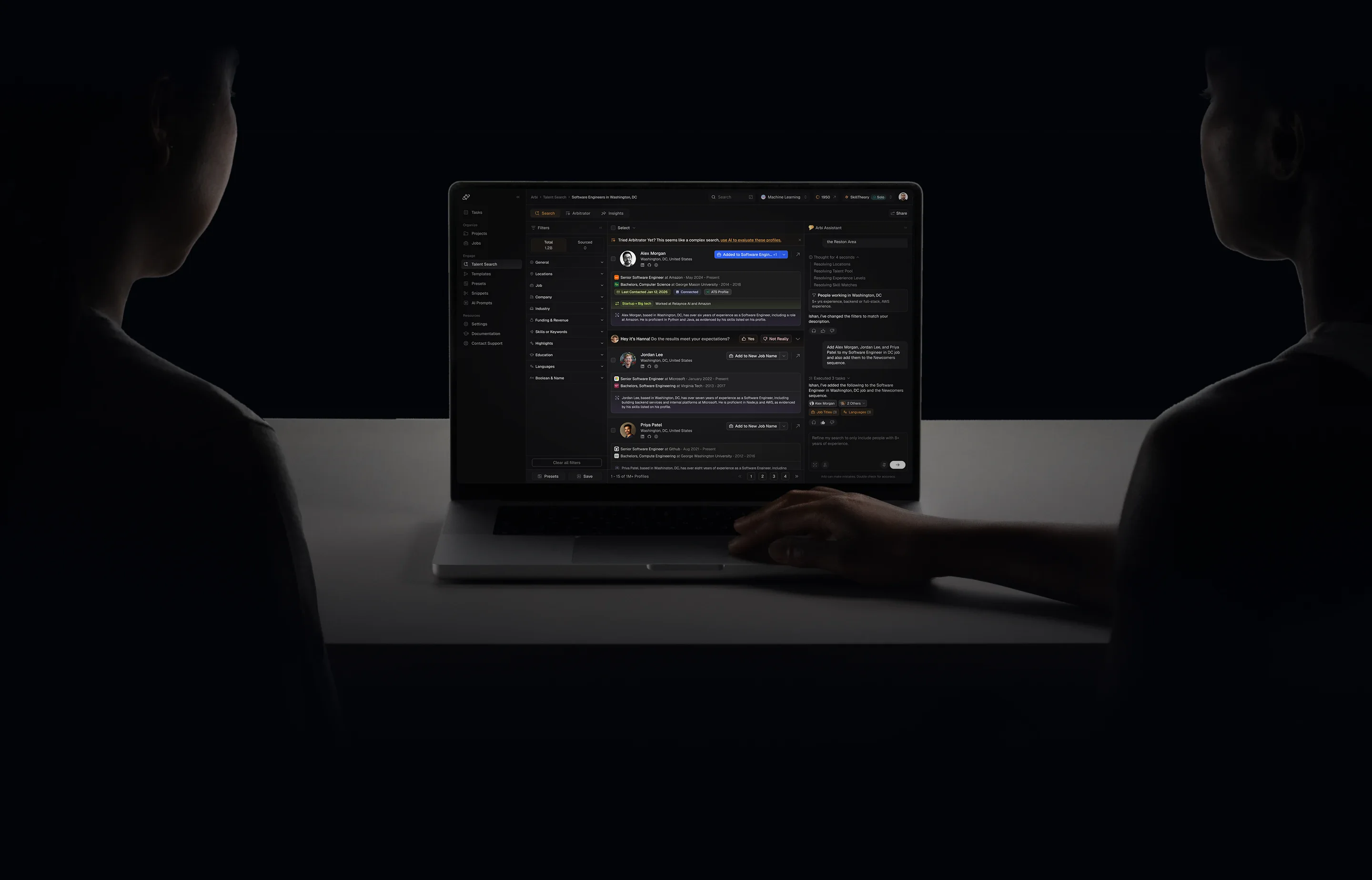
Neuroscale built Arbi specifically to address the trust deficit in AI hiring tools. The company's philosophy: AI should make talent teams more capable, not obsolete. That means:
- Explainable recommendations: Every candidate ranking includes the reasoning; skills matched, evidence from materials, gaps identified
- Human decision-making: Arbi surfaces candidates; recruiters and hiring managers decide
- Bias monitoring built in: Track selection rates, flag patterns, export reports for audit
- Transparent about limitations: The tool admits what it doesn't know and where human judgment is essential
The goal isn't to automate hiring. It's to give talent teams superpowers: see more candidates, make fairer decisions, and spend time on the human parts of hiring (relationships, culture fit, coaching) instead of drowning in resume review.
When people ask "Will AI take recruiter jobs?" Neuroscale's answer is clear: not if we build it right.
The Path Forward: Better Communication, Better Tools
The perception gap between AI's actual impact (1% of layoffs) and its perceived impact (much higher) won't close overnight. But it can close through better communication and better tools.
Better communication means:
- Being honest about why restructuring happens (not just citing "AI transformation")
- Explaining how AI is actually used in hiring (specifics, not buzzwords)
- Acknowledging fears instead of dismissing them
Better tools means:
- AI that shows its work, not just its results
- Systems that keep humans in control
- Technology that helps teams hire better, not just faster
The gap exists because trust has been eroded. Rebuilding it requires transparency, honesty, and tools designed with humans, not just efficiency, in mind.
The Bottom Line
Only 1% of layoffs are actually due to AI. But the perception gap is real, and it's creating challenges for talent teams trying to adopt AI responsibly.The solution isn't to avoid AI. It's to use it transparently.
When companies are clear about how AI is used, when tools show their reasoning, and when humans remain in control of decisions, the perception gap starts to close. And when that happens, talent teams can focus on what matters: finding great people and building great teams.
Join the Conversation
What's been your experience with the AI perception gap? Are candidates asking more questions about how AI is used in your hiring process? How are you building trust?
Neuroscale wants to hear from talent leaders navigating these challenges.
Share your perspective: [email protected]
About Neuroscale AI: Neuroscale builds Arbi, an AI evaluation tool designed to be transparent, explainable, and human-centered. The company believes AI should amplify human capability—not replace it. Learn more at neuroscale.ai.
Sources:
- Oxford University: Recent research on AI impact on employment
- CNBC: "Companies are scapegoating AI for job cuts"
- World Economic Forum: Future of Jobs Report 2025
- Future of Recruiting Report 2025