You've seen the headlines. Entry level job postings in the U.S. down about 35% since January 2023. A Stanford study showing entry level employment in AI-risk jobs plunged 13% since 2022. Bill Gates talking about it. The World Economic Forum putting out reports. Professional networks full of anxious Gen Z workers wondering if they'll ever get a first job.
We keep going back and forth on how alarmed to be. Some days we read these numbers and think the industry is sleepwalking into something ugly. Other days it looks like the media doing what it always does with technology, finding the scariest framing and running with it. The truth, annoyingly, is probably somewhere in between.
But here's what bugs us about the whole conversation: almost nobody is asking the right question. The debate keeps circling "Will AI kill entry-level jobs?" when the actual question is "Who gets to decide what happens to the people caught in the middle of all this?"
The numbers are bad. Let's not sugarcoat that.
The World Economic Forum's 2025 Future of Jobs Report says 40% of employers plan to cut staff where AI can automate tasks. Not "someday." Now. Tech postings on Indeed are down 36% from early 2020 levels. Software development, which was supposed to be the safe career? Lost nearly 20% of its jobs since ChatGPT showed up.
If you graduated recently or you're trying to change careers, honestly, there's not much to say about these numbers that isn't depressing. The ladder got pulled up. That's just what happened.
Companies scrambling to automate every junior role are making the problem worse. But this is the part of the conversation that frustrates us.
The people who actually do hiring are being ignored
Go read the discourse. One camp wants regulation, slowdowns, job protection. The other camp says new jobs will appear, stop complaining, learn to code (again). Both sides are talking about workers like they're an abstraction.
Nobody seems interested in what's happening inside actual talent acquisition teams right now. We talk to recruiters constantly (it's kind of our whole thing) and they're stuck in an impossible spot. They're looking at 2,000 applications for a single role and thinking: if we use AI to screen these, are we part of the problem? If we don't, the team burns out and we miss our hiring targets anyway. And half the applications were written by ChatGPT in the first place, so what are we even evaluating?
These aren't hypothetical dilemmas. Recruiters are dealing with this today, right now, and the broader AI employment debate just sort of... talks past them.
The industry is framing AI in hiring wrong
Controversial opinion, maybe: the goal with AI in hiring should not be "automate away the junior recruiter." It should be "take the recruiter who's drowning in applications and help them actually do their job."
There's a difference. A big one.
When someone gets 2,000 resumes for one opening, the bottleneck isn't processing speed. It's that good people disappear into the pile. Think about the career changer who built an incredible portfolio but formatted their resume in a way that confuses the ATS, or the bootcamp grad with three years of shipped projects but no computer science degree. These people aren't unqualified. They're just invisible to keyword filters and overworked humans who have maybe 30 seconds per resume.
That's the part AI could actually help with. Not making the final call, but surfacing people who would've gotten lost and giving recruiters better information to judge with.
Most companies are buying AI hiring tools for the wrong reasons
We see this constantly. A company evaluates an AI hiring product and their eyes light up at the efficiency pitch. Screen ten thousand resumes in ten minutes. Cut time to hire by half. Maybe get rid of a couple recruiters.
Those are the wrong metrics to optimize for. The questions they should be asking: are we finding people we would've missed before? Can we explain why we rejected someone? Because if your hiring process has problems (and every hiring process has problems) speeding it up doesn't fix anything. It just produces bad outcomes quicker.
One stat we keep coming back to: the 2025 Future of Recruiting Report says 51% of TA professionals think AI can improve quality of hire. Improve. Not replace. That distinction gets lost.
The "entry level job apocalypse" is mostly a mislabeling problem
PwC's 2025 Global AI Jobs Barometer says something that doesn't get enough attention: AI can make workers more valuable, not less, even in jobs that are highly automatable. Which sounds counterintuitive until you think about it for a minute.
What's actually happening is that the definition of "entry-level" is shifting. The data entry clerk role is disappearing, but data quality analyst is appearing in its place, because someone still needs to check the work the AI did. Same thing with junior copywriter turning into brand voice editor, or resume screener becoming something more like a talent intelligence specialist who interprets AI recommendations and pushes back when they're off.
These aren't worse jobs, just different ones. And companies need to catch up to that. "Entry-level" can't keep meaning "the stuff nobody wants to do" if the stuff nobody wants to do is getting automated. It has to mean "where people start learning."
So what does "ethical AI hiring" actually look like in practice?
Companies are going to use AI in hiring. That ship sailed. Pretending otherwise is a waste of everyone's time. The useful conversation is about how they use it.
Transparency is the obvious starting point but most tools fail at it badly. If the software can't tell you why it ranked one candidate above another, you don't have an AI hiring tool. You have a magic 8-ball with a nicer interface. A good system shows the recruiter which skills matched, where the gaps are, and why the ranking looks the way it does. You should be able to show a rejected candidate what happened and what would make them stronger next time. Most companies can't do that today. That should bother people more than it seems to.
The human-in-the-loop thing sounds obvious but companies keep getting it wrong. "Humans review the AI's picks" is not human oversight. That's rubber stamping. Real oversight means the recruiter is asking if the recommendation makes sense for the team and if there's context the system couldn't see. A good test: would you be comfortable explaining this hire, or this rejection, to someone who challenged it?
And then there's bias. Every AI tool trained on historical hiring data will inherit the biases baked into that data. This isn't a maybe. The relevant question isn't "is our AI biased" (it is) but whether anyone is watching the outputs and stepping in when the patterns look off. Most companies don't do this. Some because they don't know how, some because they'd rather not find out.
Black box tools are a liability, not an asset
Let's be direct. If a company is using AI to hire faster but not to hire better, they are making things worse. And if the tool can't explain its own decisions, that company hasn't reduced bias at all. They've just made it harder to see.
Questions to push on if you're evaluating vendors
If your company is shopping for AI hiring tools, here's what we'd ask:
"Show us why the AI ranked these candidates this way." If the vendor says "proprietary algorithm" or gives you a score with no explanation, that tells you something. Walk.
"What happens to the people the system filters out?" Do they vanish? Can they reapply later? Does anyone tell them what happened? Ghosting candidates at scale is still ghosting candidates.
"How would we know if this is amplifying our biases?" You want adverse impact reports. You want to see what happens when the numbers look weird. And honestly, you want to think about how you'd explain your process to the EEOC, because eventually someone's going to ask.
"What are humans actually responsible for?" If the answer is reviewing a shortlist the AI produced, that's not enough. People need to be calibrating the tool, overriding it when it's wrong, learning from where it fails.
"Is the real goal fewer people or better outcomes?" Sometimes the honest answer is headcount reduction, and that's a legitimate business choice. Just don't call it "augmentation" if that's what you're doing.
Where we think this goes
Five years from now, the companies with the best teams won't be the ones that automated their hiring the fastest. We're fairly sure of that. They'll be the ones who used AI to notice candidates everyone else missed. People whose resumes didn't fit the standard template, people who came to the field sideways and got overlooked the first time around.
The companies that treated AI as a cost cutting tool and nothing else? Some of them will be in court, trying to explain why their automated system kept rejecting candidates from specific demographic groups. Others will have hollowed out talent pipelines because they optimized for speed over quality for so long that the good people stopped applying. The rest will just have exhausted teams, because "AI-powered" in practice meant fewer people doing more work.
Maybe that's a cynical read. We'd rather be wrong.
What we're building at Neuroscale, and why
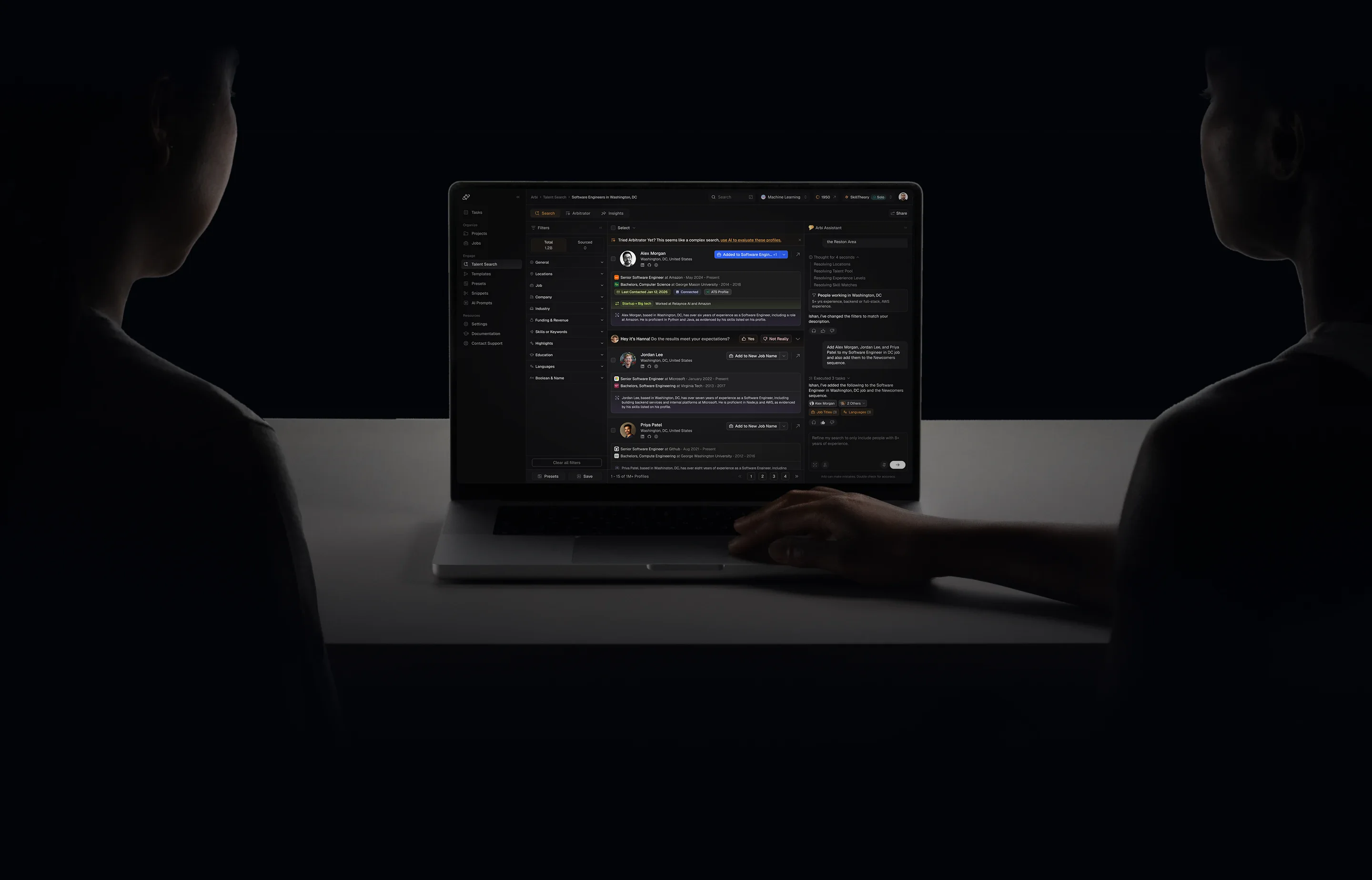
We built Arbi on a bet that we think is going to age well: AI should make talent teams more capable, not smaller.
What that looks like concretely: every recommendation Arbi makes comes with an explanation you can audit. The system recommends, humans decide. Adverse impact tracking is built in and you can export the reports. Arbi also looks in places most tools don't, like past applicants who might fit a new role, or candidates with adjacent skills that map to the job even if the keywords don't match.
We don't think the entry level job crisis is really about AI stealing work. We think it's about companies reaching for the easiest application of a powerful technology instead of the most useful one. We're trying to build for the companies that want the useful version.
Bottom line
Entry level jobs are down 35% since 2023. AI is part of why, but it's not the only reason, and the way the media frames it makes it hard to have a productive conversation about what to do.
The things we keep thinking about: who's actually controlling how these tools get deployed? What's the plan for the people who are caught between the old job market and the new one? And when a company says it's using AI in hiring, is it building something that helps humans make better decisions, or just something that makes decisions faster and cheaper?
Leaders in this space have to pick. You can use AI to cut corners on hiring, or you can use it to actually get better at it. The second option takes more work. It's also the one where you don't end up in the newspaper for the wrong reasons.
If you have thoughts on any of this, we'd genuinely like to hear them: [email protected]. Especially if you're a recruiter living through this, or someone early in your career trying to figure out what comes next.
Related Reading: