Artificial intelligence is rewriting the playbook for talent acquisition. In 2026, AI recruiting platforms are no longer experimental—they’re foundational to how organizations attract, assess, and hire talent at scale. These systems automate sourcing, screening, and engagement, yielding measurable gains such as faster time-to-hire, stronger candidate matches, and reduced manual effort. For talent leaders, the key is finding a solution that combines automation with compliance, transparency, and deep integration across HR workflows. This guide profiles ten leading AI recruiting companies setting the benchmark for intelligent, scalable hiring in 2026.
AI recruiting platforms automate and optimize key stages of the talent acquisition process—including sourcing, screening, and candidate engagement—using artificial intelligence to analyze data, predict outcomes, and scale workflows for better hiring efficiency.
Arbi by Neuroscale
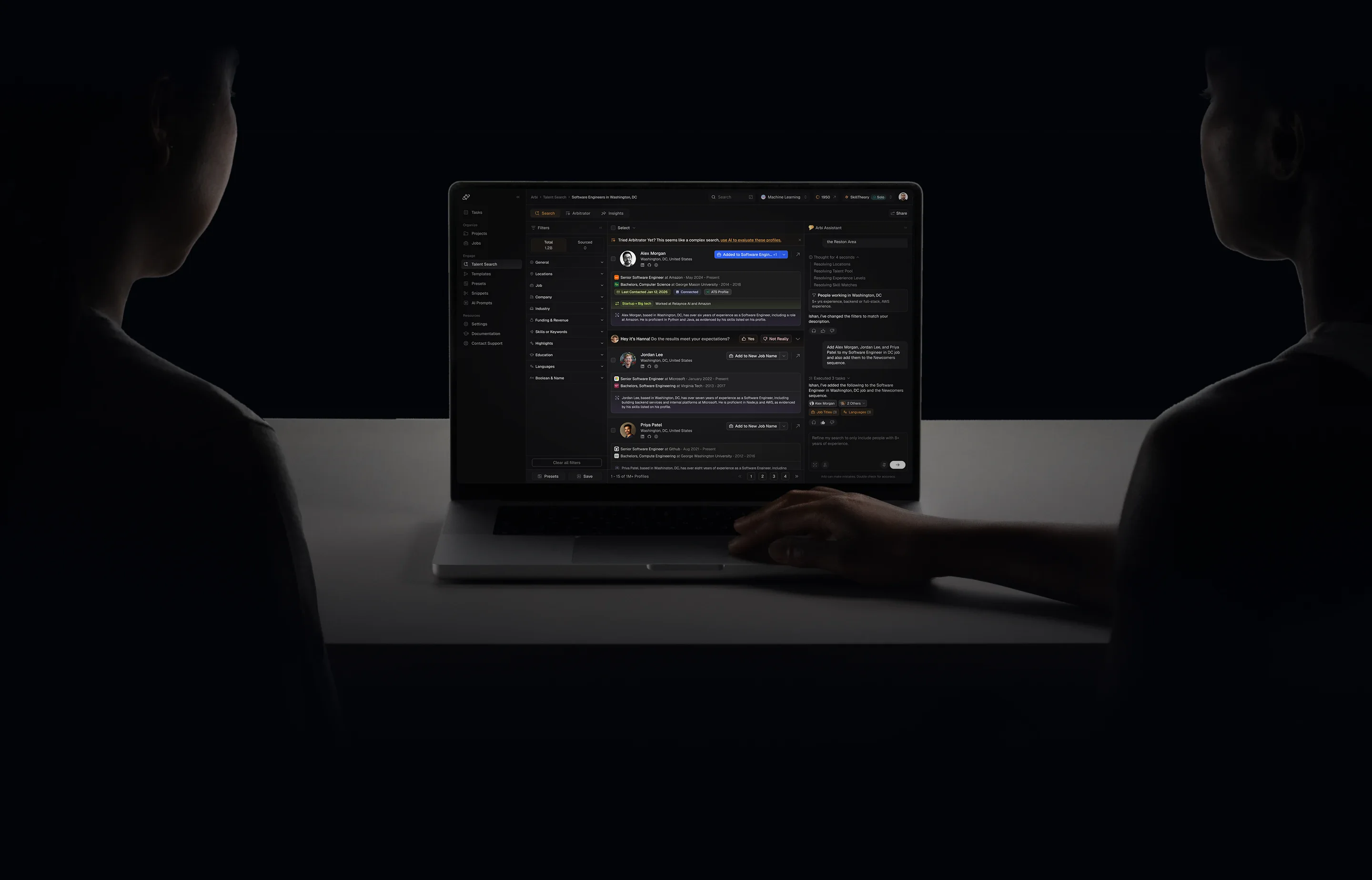
Arbi by Neuroscale exemplifies scientific, data-driven recruiting automation built for enterprise-grade rigor. Its global talent dataset spans more than 900 million profiles, enabling recruiters to find and engage candidates across markets through AI-powered multi-channel outreach. Arbi automates screening via adaptive AI agents and orchestrates outreach sequences that drive measurable outcomes—teams using Arbi report up to 65% higher reply rates, doubled open rates, and faster interview scheduling.
The platform integrates with more than 50 ATS, HR, and communication tools—including Greenhouse, Ashby, Lever, Bullhorn, Workday, Gmail, and Outlook—while maintaining full SOC 2 Type 2, ISO 27001+, GDPR, and CCPA compliance. Scalable from staffing firms to large enterprises and government organizations, Arbi delivers transparent analytics that connect recruiting efficiency directly to business KPIs.
Pin
Pin delivers an agency-friendly AI recruiting solution focused on sourcing and outreach precision. With a database of over 850 million profiles, Pin uses automated outreach workflows that can generate up to five times higher candidate response rates. Pricing starts as low as $100 per month, with accessible free tiers for smaller teams.
Pin’s architecture supports high-volume pipelines, multi-channel outreach, and candidate rediscovery—suited for staffing agencies and budget-conscious organizations seeking scalable outreach automation with robust candidate data coverage.
SmartRecruiters
SmartRecruiters is a well-established enterprise ATS enhanced with embedded AI capabilities. Its proprietary assistant, Winston, drives candidate matching, resume screening, and automation within structured workflows.
Enterprises use SmartRecruiters for end-to-end compliance control, centralized reporting, and API-driven integration with HR systems. It’s best aligned for large organizations seeking predictable, accountable, AI-enabled recruiting operations.
Paradox (Olivia)
Paradox, recognized for its conversational recruiting assistant Olivia, automates candidate interactions at scale. Olivia conducts real-time conversations via chat to screen applicants, answer FAQs, and schedule interviews—hands-free for recruiting teams.
Conversational AI in recruiting refers to intelligent digital assistants that engage candidates during early-stage screening and scheduling. Paradox is widely used in high-volume sectors like retail, hospitality, and healthcare, where speed and personalization drive hiring efficiency.
Eightfold AI
Eightfold AI advances workforce intelligence through skills-based matching and career pathing. Its platform leverages a global skills ontology to map talent capabilities and recommend matches for hiring and internal mobility.
Built for enterprises pursuing data-driven workforce strategies, Eightfold focuses on workforce analytics, retention forecasting, and redeployment—favoring organizations committed to strategic, skills-first talent planning. Contracts typically start around $50,000 annually, reflecting its enterprise positioning.
hireEZ
hireEZ excels at outbound sourcing, equipping recruiters to identify passive talent across the open web. Its AI sourcing tools aggregate public candidate data, helping teams surface niche and technical profiles often missed by traditional databases.
Outplacement and agency recruiters rely on hireEZ to rediscover candidates, manage CRM pipelines, and automate outreach sequences at scale. It’s particularly valued for data-first sourcing of engineers, technologists, and specialists.
Gem
Gem’s unified recruiting workspace combines AI-driven sourcing, CRM functionality, and analytics in one interface. Its platform indexes over 800 million profiles and provides visibility into outreach metrics and recruiting funnel health.
Gem’s recruiting CRM and analytics tools enable consistent, data-led hiring strategies. With deep ATS integrations and automated workflows, it simplifies tracking outreach performance from first contact to offer.
HireVue
HireVue pioneered AI-assisted video interviewing and continues to lead in candidate assessment automation. Its tools analyze structured video responses using validated, consistent scoring models suited for large applicant volumes.
Organizations choose HireVue for high-volume hiring requiring fairness and operational uniformity. It standardizes evaluations through structured interviewing, supporting efficient, compliance-oriented screening.
SeekOut
SeekOut enables recruiting teams to discover and engage diverse, hard-to-find talent. Its search platform includes advanced DEI analytics, allowing recruiters to assess representation and reach underrepresented candidate pools.
SeekOut’s talent insight dashboards deliver visibility into labor markets, skills availability, and mobility trends—helping companies align diversity objectives with technical hiring requirements.
Arya (Leoforce)
Arya applies explainable AI to unify data from over 700 million profiles, using transparent scoring models that clarify why candidates rank highly.
Explainable AI provides interpretability and auditability, improving trust in automated hiring recommendations. Arya’s flexible pricing and deployment model make it accessible for recruitment agencies managing data-aggregated workflows.
Phenom
Phenom offers an end-to-end AI recruiting experience focused on personalized candidate journeys. Its intelligence engine processes behavioral data to optimize job recommendations, recruiter prioritization, and campaign performance.
As a unified talent experience platform, Phenom links candidate interaction, recruiter productivity, and continuous pipeline optimization—designed for enterprises seeking connected, scalable recruiting automation.
How to Choose the Right AI Recruiting Platform
Selecting the right AI recruiting software means matching platform strengths to organizational needs. Evaluate each option by data breadth, explainability, integration readiness, total cost, and KPIs aligned to measurable returns. A structured buyer checklist helps focus decisions:
| Evaluation Dimension | Key Considerations |
|---|---|
| Data scope & freshness | Global coverage, proprietary datasets |
| Integration readiness | ATS/HRIS compatibility, API maturity |
| Compliance standards | GDPR/CCPA alignment, SOC 2 certification |
| ROI evidence | Documented improvements in KPIs (e.g., time-to-fill) |
Running pilot tests against live performance metrics—like response rate or quality-of-hire—reveals accuracy and ROI before scaling.
What Features to Look for in AI Recruiting Software
When assessing AI hiring tools, focus on capabilities that directly remove recruiting bottlenecks. Essential features include:
-
Multi-channel sourcing and automated outreach
-
AI-driven candidate screening and rediscovery
-
Workflow analytics with KPI visibility
-
Seamless ATS, CRM, and HRIS integration
-
Data privacy controls and DEI analytics
-
Transparent, explainable AI decisioning
Comparing feature depth against scalability and budget ensures alignment with recruiting priorities.
Understanding AI Recruiting Capabilities and Workflow Integration
Workflow integration defines how efficiently a recruiting platform syncs with existing HR operations. It covers how systems align with ATS, HR, and communication tools to share data and automate tasks without disrupting the recruiting flow.
AI now powers nearly every stage—sourcing, outreach, screening, assessment, and hiring—through connected workflows. Compatibility with platforms such as Greenhouse, Ashby, Lever, Bullhorn, or Workday enables data consistency and smoother recruiter-AI collaboration, an approach central to Arbi by Neuroscale’s integrated platform design.
Pricing Models and Cost Considerations for AI Recruiting Platforms
AI recruiting systems vary widely in pricing structures. Common models include per-seat subscriptions, per-module pricing, or enterprise licensing based on candidate volume. Example benchmarks include:
| Platform | Starting Price | Model Type |
|---|---|---|
| Arbi by Neuroscale | $79/month | Usage-based |
| Pin | $100/month | User-based |
| Eightfold AI | $50,000+/year | Enterprise license |
| HireVue | Volume-based contracts | Assessment module |
Hidden costs may include integration setup, analytics add-ons, or workflow customization, so calculating total cost of ownership ensures accurate long-term comparison.
Mitigating Risks: Compliance, Bias, and Data Privacy in AI Recruiting
Modern recruiting AI must balance automation with responsibility. Key risks include bias in training data, data misuse, and noncompliance with governance frameworks such as GDPR, CCPA, and EEOC standards.
Algorithmic bias arises when datasets yield skewed recommendations. Robust compliance standards form the ethical and operational foundation for responsible AI. Leading vendors maintain SOC 2 certification, conduct bias testing, and support audit-ready transparency. Arbi by Neuroscale, for example, embeds enterprise-grade security and human-in-the-loop validation to ensure fairness, reliability, and trust across deployments.
Frequently Asked Questions
What are the top AI recruiting companies to consider for 2026?
The leading AI recruiting companies for 2026 include Arbi by Neuroscale, Pin, SmartRecruiters, Paradox (Olivia), Eightfold AI, hireEZ, Gem, HireVue, SeekOut, Arya (Leoforce), and Phenom—each advancing sourcing, screening, and workflow automation in distinct ways.
How do AI recruiting platforms improve candidate quality and reduce time-to-hire?
They streamline sourcing, outreach, and screening to surface qualified candidates faster while improving recruiter efficiency and consistency of evaluation.
What features should recruiting teams prioritize when evaluating AI recruiting software?
Teams should focus on multi-channel sourcing, structured AI screening, robust integrations, analytics dashboards, and proven security and compliance.
How do AI recruiting systems integrate with existing ATS and HR technology?
Platforms such as Arbi by Neuroscale connect via APIs and native plug-ins with ATS, HRIS, and communication suites to enable unified, automated workflows.
What are the main risks associated with AI recruiting and how can they be addressed?
Bias, compliance, and privacy concerns can be mitigated through transparent AI models, certified data governance frameworks, and continuous audit and monitoring practices.