Ask a recruiter why screening takes so long and you will hear about volume. Four hundred applicants, one req, one person. The number is real, but it is not the reason. Reading four hundred profiles at ninety seconds each is nine hours of work: a long day, not an impossible one.
The reason screening takes so long is that nobody can tell you when it is finished. There is no line the pile is measured against, so the work has no end state, only a point of exhaustion. What gets called a throughput problem is almost always a measurement problem wearing a throughput costume.
The tenth resume is not the first resume
The first profile of the morning gets read. The tenth gets skimmed. The hundredth gets pattern-matched against the nine before it, which is a polite way of saying it gets compared to the wrong thing.
This is not a failure of diligence. It is what attention does under load, and it has been measured in radiologists, air traffic controllers, and appellate judges before anyone got around to measuring it in recruiters. The consequence in hiring is specific and expensive: the bar drifts. Not randomly, but in the direction of whatever the reviewer has just seen. Five strong backend profiles in a row and the sixth gets judged against them rather than against the role.
By the end of the stage you have a shortlist that is internally inconsistent in ways nobody can reconstruct, because the standard existed only in one person's head and it was moving the whole time.
A shortlist is a claim about a group of people. If you cannot say what the claim was measured against, you have produced a preference, not a decision.
What a criterion has to do to be useful
The instinct, once you accept that the standard needs writing down, is to write down what you already say out loud. That is where most scorecards die. "Strong engineer." "Good communicator." "Startup mindset." These read like requirements and function like mirrors. Every reviewer sees their own definition in them, so the scorecard produces the same drift it was meant to prevent, now with a paper trail.
A criterion earns its place when two people reading the same profile would reach the same verdict on it. That is a high bar and it rules out most of what ends up on an intake form.
| Instead of | Write |
|---|---|
| Strong backend engineer | Has owned a service in production handling meaningful traffic, not only feature work inside someone else's service |
| Startup experience | Was employee number one to fifty at a company under 200 people, for at least eighteen months |
| Good with data | Has written and maintained SQL against a production warehouse, not only consumed dashboards |
| Leadership potential | Has been the named technical owner of a project involving at least three other engineers |
The right-hand column is longer, uglier, and testable. That last property is the only one that matters. You will also notice that writing it forces an argument with the hiring manager that would otherwise have surfaced in week five, when the first shortlist gets rejected for reasons nobody articulated in the intake.
Three ways a written standard still fails
Writing the criteria down is necessary and not sufficient. There are three reliable ways it still falls apart.
- The criteria are never re-read. They get written at intake, and by profile forty the reviewer is working from memory again. A standard that lives in a document nobody has open is a standard that is not being applied.
- Everything is weighted the same. Nine criteria, all mandatory, means the ninth one (usually something like "based in a compatible time zone") knocks out candidates who are exceptional on the first three. Ordering by importance is not a nicety; without it a checklist optimises for the inoffensive.
- The verdicts are not recorded. If the output is a yes or a no with no note attached, the reasoning evaporates. Six weeks later, when the hiring manager asks why a particular person was not advanced, the honest answer is that nobody knows.
Each of these is a bookkeeping failure, and bookkeeping is precisely the kind of work that people are bad at and software is good at.
What changes when the machine holds the standard
Once criteria are explicit, ordered, and applied by something that does not get tired, the shape of the work changes. The reviewer stops being the instrument and becomes the person reading the instrument.
Concretely: every profile in the stage is evaluated against every criterion, the results come back as a percentage plus a per-requirement verdict, and the pile arrives sorted. The nine hours of reading do not disappear. They get spent differently. Instead of ninety seconds on all four hundred, you spend fifteen minutes on the forty at the top and twenty minutes on the boundary cases in the middle, which is where the actual judgement lives.
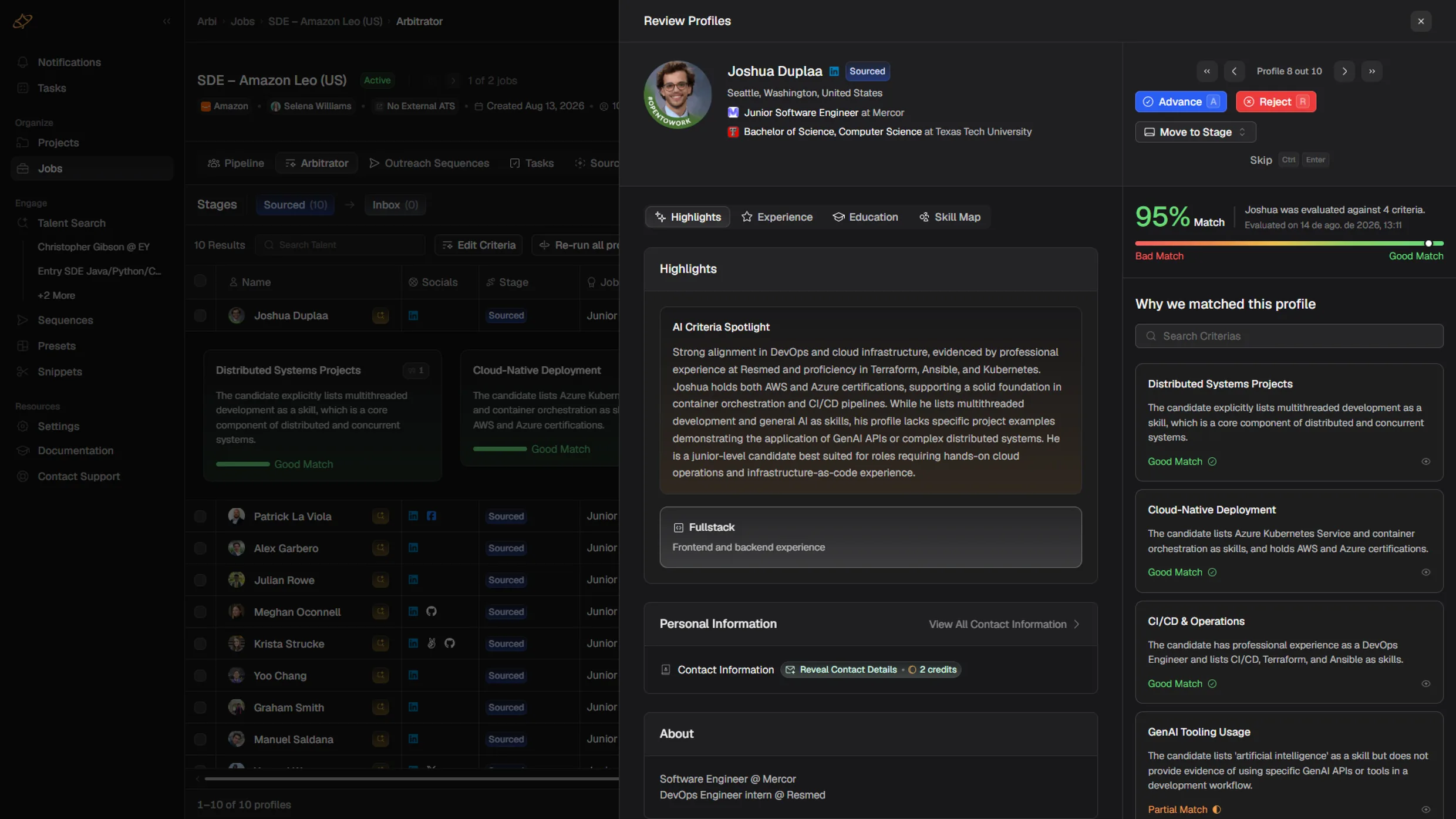
The second change is subtler and more valuable. Because the standard is written and the verdicts are recorded, you can audit the standard itself. Sort the rejects, read twenty of them, and it becomes obvious within minutes whether a criterion is doing what you meant it to do. Ours regularly are not. The fix takes thirty seconds and re-running the stage takes one click, which is the first time in most recruiting workflows that being wrong has been cheap.
Where this still needs a person
None of the above decides anything. It cannot, and the moment a screening tool starts silently discarding profiles on your behalf you have lost the only property that made writing the criteria worthwhile: that a human can check the work.
There are also things a criterion will never capture. A candidate who has done something adjacent and unusual, who is early in a steep trajectory, who wrote a cover letter that tells you more than the six roles above it. Those are found by reading, and they are found more often when the reader still has attention left at profile three hundred.
That is the trade the whole thing rests on. Machines are good at applying the same standard four hundred times. People are good at noticing the profile the standard was never designed for. Screening breaks when you ask either one to do the other's job.