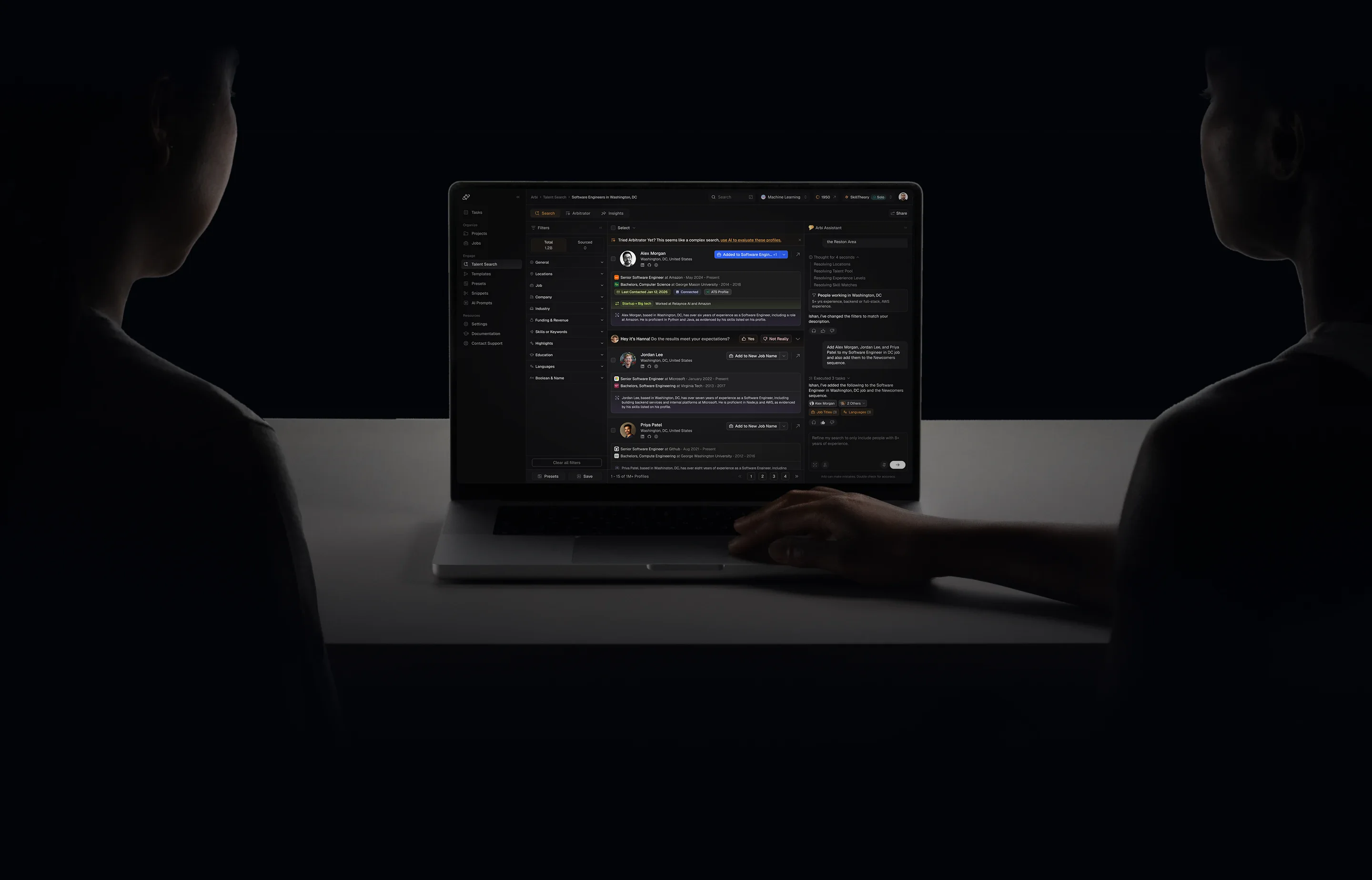

The problem
Public sector contracts oblige you to show your work. Not to have done the work well, though that too, but to be able to produce, months later, the reasoning behind a particular decision about a particular person.
A verdict with nothing attached is not a record. Maximus had verdicts, and it had recruiters who could usually reconstruct why they had reached one, and the gap between those two things was where the cost lived. Assembling an audit pack meant tracking down whoever had run the stage, asking them to remember, and hoping the profile had not been updated since.
Evidence as a first-class thing
The change was not to record more. It was to record differently.
Every profile is decomposed into spans: a role, a project description, a paragraph from a cover letter, a certification record. Each span carries a stable identifier and a pointer back to where it came from. When a criterion is judged, the judgement cites the spans it rests on.
That means the answer to "why did this candidate not advance" is not a recollection. It is a criterion, a verdict, and the two sentences in the source document that produced it.
Refusing to guess
The tempting behaviour, when a document does not say something, is to reason from context: the candidate was at a company that runs a particular stack, so presumably they have used it.
Maximus insisted on the opposite. Where a requirement cannot be evidenced from the document, the verdict is "not evidenced" rather than a probability. This produces more unknowns than a confident system would, and in a compliance setting that is the correct trade: an unknown is a question to ask on a screen call, while a guess is a finding waiting to happen.
Resumes are lossy documents. Plenty of true things about a candidate are simply not written down anywhere in them, and a system that pretends otherwise is inventing the part you will later be asked to defend.
What the team does with the time
The three days did not vanish into a spreadsheet. They went back into screen calls, which is where the unknowns get resolved, and which is the part of the process no export will ever replace.